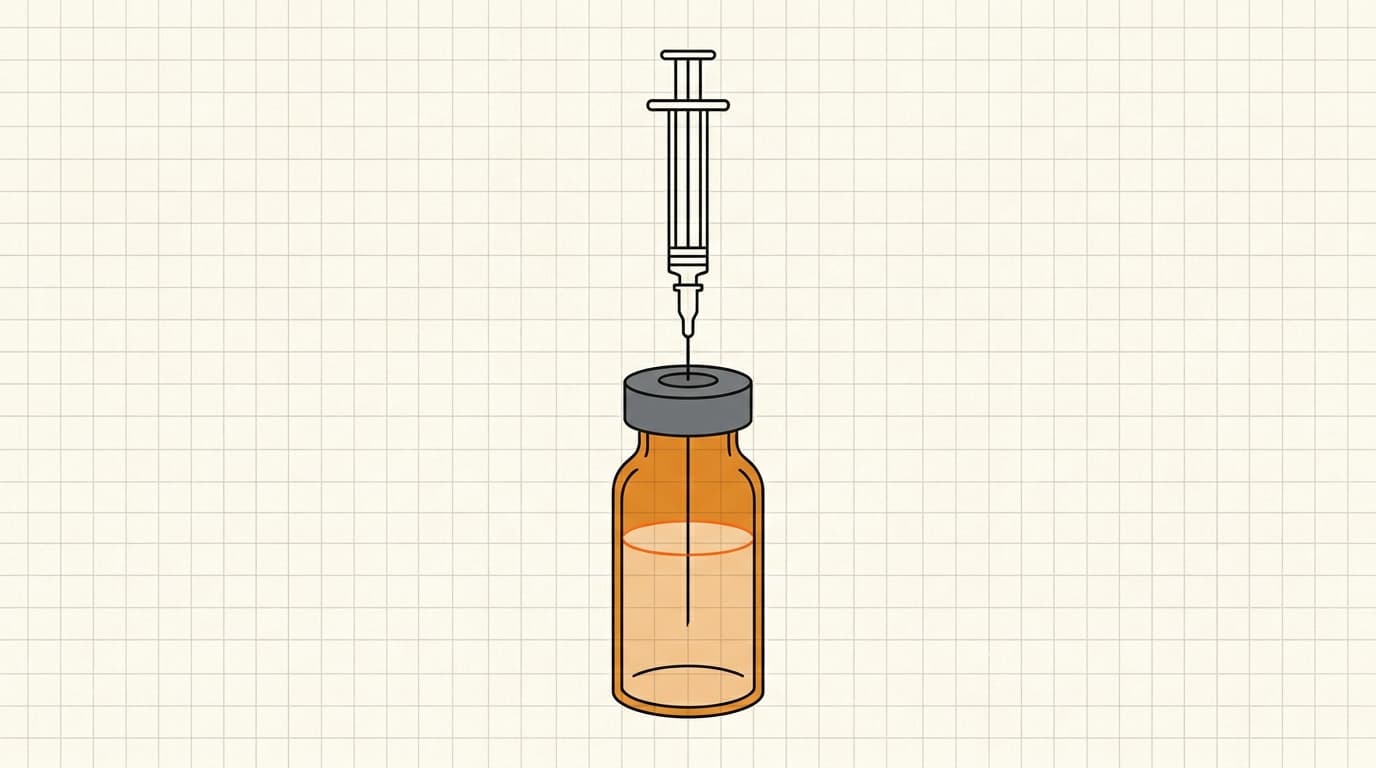
What Peptides Can You Mix in the Same Syringe? (Compatibility Chart + How to Do It)
Compatible water-based peptides can share one syringe: it saves a pin, it does not create extra synergy in the barrel. Here is the compatibility chart, the rules behind it, and the step-by-step.
By Jason Jeffries · July 2, 2026
I've never mixed two compounds in one syringe myself. Every blend I've taken came already mixed in the vial, so I can't speak to the mixing step from experience. What I can walk through is what matters if you do it yourself: the compatibility chart, the rules behind it, and the steps that keep it safe.
Yes: compatible water-based peptides can be drawn into one syringe and injected together. It saves a pin. It does not create any extra synergy in the barrel. The benefit of a stack is biological, from the compounds acting in your body, not chemical. The rules that matter: combine at injection time rather than storing a pre-mixed syringe; keep water-based peptides away from oil-based injectables like testosterone; keep GLP-1 medications (semaglutide, tirzepatide) in their own syringe; and never combine two compounds you have not confirmed are compatible: GHK-Cu and glutathione, for one, precipitate into a milky solution when mixed.
What “mixing in the same syringe” actually means
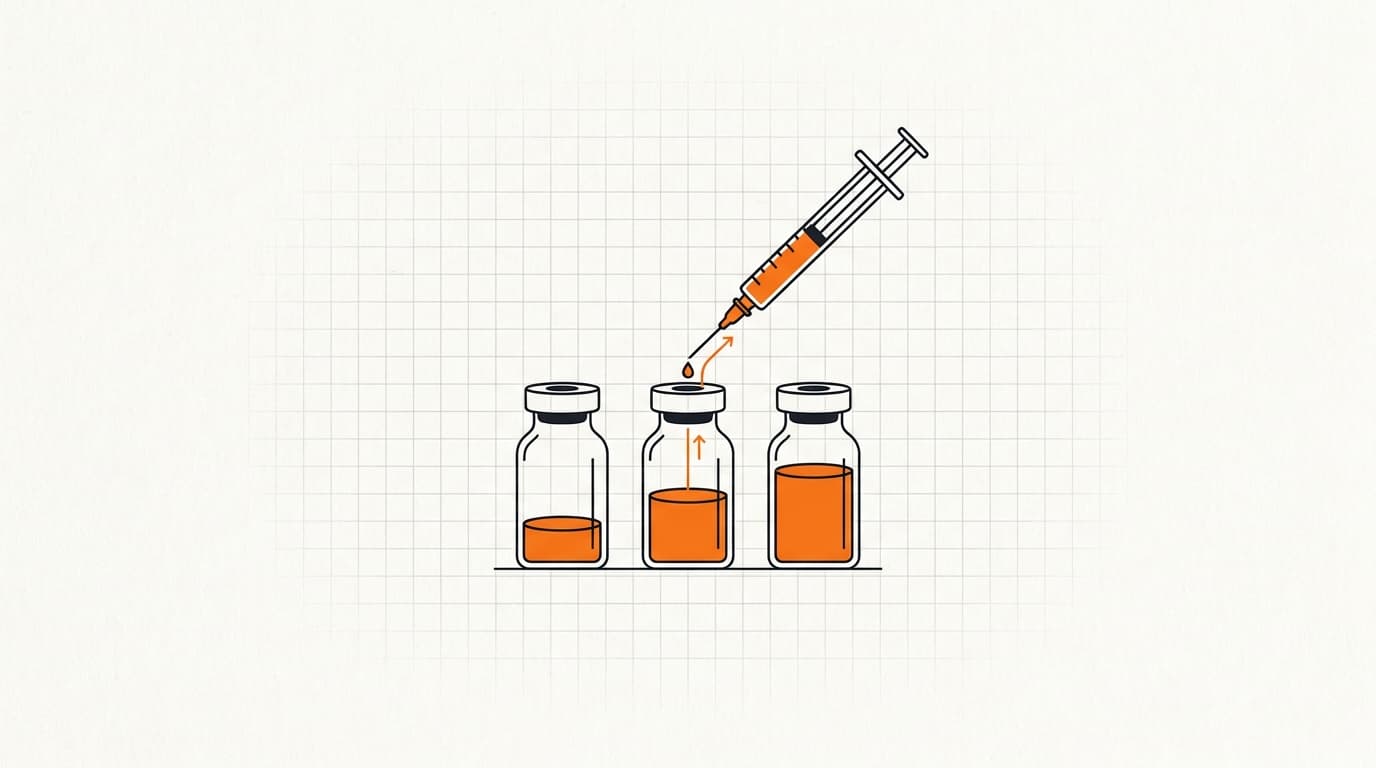
It means exactly one thing: instead of giving yourself two separate subcutaneous shots, you reconstitute each peptide in its own vial, then draw both into a single insulin syringe and inject once. That is the whole trick. It is a delivery convenience (fewer pins, one injection site), not a chemistry experiment.
The most common misconception is that combining two peptides in the barrel somehow amplifies them. It does not. Two compounds that work well together do so because of what they do in your body: a repair peptide driving angiogenesis while another promotes cell migration, say. Sharing a syringe changes nothing about that; it means one poke instead of two. So the real question is never “will this stack work better mixed?” It is “are these two safe to share a barrel, or do I need separate pins?” That is what the chart below answers.
| BPC | TB-500 | CJC | Ipa | GHK-Cu | GSH | Test* | GLP-1 | |
|---|---|---|---|---|---|---|---|---|
| BPC-157 | · | ✓ | ✓ | ✓ | ✓ | ∼ | ✕ | ∼ |
| TB-500 | ✓ | · | ✓ | ✓ | ✓ | ∼ | ✕ | ∼ |
| CJC-1295 | ✓ | ✓ | · | ✓ | ✓ | ∼ | ✕ | ∼ |
| Ipamorelin | ✓ | ✓ | ✓ | · | ✓ | ∼ | ✕ | ∼ |
| GHK-Cu | ✓ | ✓ | ✓ | ✓ | · | ✕ | ✕ | ∼ |
| Glutathione | ∼ | ∼ | ∼ | ∼ | ✕ | · | ✕ | ∼ |
| Testosterone | ✕ | ✕ | ✕ | ✕ | ✕ | ✕ | · | ✕ |
| Semaglutide | ∼ | ∼ | ∼ | ∼ | ∼ | ∼ | ✕ | · |
The rules behind the chart
Every green, amber, and red cell above comes from one of three rules. Learn the rules and you can place a compound that is not on the chart yourself.
Or skip the mental math: check any two compounds → The free tool runs these same rules across 28 compounds and gives you a verdict instantly.
1. Water-based peptides can share a syringe with each other
Almost every research peptide you reconstitute (BPC-157, TB-500, CJC-1295, Ipamorelin, GHK-Cu, tesamorelin) is dissolved in bacteriostatic water. They share the same aqueous carrier, so two of them draw up into one clear solution without separating. This is why the classic pairings work in a single pin: BPC-157 + TB-500 for tissue repair, and CJC-1295 + Ipamorelin (a GHRH analog paired with a ghrelin mimetic) for growth-hormone support; both are routinely drawn together and also sold as pre-blended vials.
2. Water and oil do not mix in the barrel
Injectable testosterone and other anabolic-androgenic steroids are oil-based: the hormone is suspended in a carrier oil, not water. Draw a water-based peptide into the same syringe as an oil and you get two separated phases, not a solution, plus two very different injection characteristics (peptides go subcutaneous with a tiny insulin pin; oils typically go deeper with a larger gauge). Keep peptides and oil-based injectables in separate syringes, always. The mirror-image rule is worth knowing too: two oils combine with each other fine: drawing, for example, one oil ester into a syringe already holding another is standard practice with no chemical interaction; you swap to a fresh needle before injecting.
3. A few specific pairs react: confirm before you combine
Same carrier is necessary but not always sufficient. The cleanest documented example in our knowledge base is GHK-Cu + glutathione: both are water-based, yet a user reported the solution turning visibly milky white mid-injection when the two were combined (a precipitation reaction). Copper peptides and strong antioxidants can chemically interfere even though the carrier matches. The takeaway is the safe default: if you have not confirmed two specific compounds are compatible, give them separate pins: a second injection costs seconds; a precipitated dose costs the whole draw.
GLP-1 medications (semaglutide, tirzepatide, retatrutide) are water-based, so they will not curdle with a peptide the way oil would. The reason to keep them on their own is practical, not chemical: they are dosed once weekly on carefully titrated volumes, a completely different cadence from the daily peptides above. Co-drawing a weekly GLP-1 with a daily peptide only muddies your dosing and your schedule. Run the GLP-1 as its own injection.
Common combinations people actually run
These are the pairings that show up again and again, and why they share a pin cleanly:
| Combination | Why it works in one syringe |
|---|---|
| BPC-157 + TB-500 | The “Wolverine” tissue-repair pair. Both water-based; drawn from separate vials into one pin so each dose stays independently adjustable. |
| CJC-1295 + Ipamorelin | GHRH analog + ghrelin mimetic for GH support. Same daily cadence, same aqueous carrier; often sold pre-blended, easily co-drawn. |
| BPC-157 + GHK-Cu | Repair + copper regeneration peptide, both subcutaneous and water-based; a common combined-ratio protocol. |
| Tesamorelin + Ipamorelin | Another GHRH-analog / secretagogue pairing on a shared daily schedule; the same logic as CJC-1295 + Ipamorelin. |
How to combine two peptides safely, step by step
- Reconstitute each peptide in its own vial. Add bacteriostatic water to each separately and let it dissolve fully. Do not pre-blend the powders. Keeping them in separate vials is what lets you adjust one dose without disturbing the other.
- Work out the volume for each compound's dose. Volume (mL) = dose (mcg) ÷ concentration (mcg/mL). Each vial has its own concentration, so each peptide has its own draw volume: getting this right per compound is the part people fumble.
- Draw the first peptide, then the second, into the same syringe. Pull the first compound to its mark, then draw the second on top of it up to the combined total. The two water-based solutions mix in the barrel.
- Check for cloudiness before you inject. A compatible combined draw stays clear. If it turns milky or you see particles, stop: that is a precipitation signal (the GHK-Cu + glutathione failure mode). Discard and give the two their own pins.
- Inject promptly. Combine at injection time, not in advance. Do not park a pre-mixed syringe in the fridge for later.
The one arithmetic-heavy step is #2: the per-compound dose math for a combined draw. You can run your own numbers on the free Blend tab of the Dosing Calculator: enter each peptide's vial size, water volume, and target dose, and it returns the units to draw for each one and the combined total. It is the same engine built into the Stackeddd app, so the numbers match what you see when you log the injection.
When NOT to combine
- A water-based peptide with any oil-based injectable (testosterone, nandrolone, any AAS). Different carrier, different needle: separate syringes.
- A GLP-1 with anything. Weekly cadence, titrated dosing. Keep it in its own pin.
- Any pair you have not confirmed is compatible, and specifically GHK-Cu + glutathione, which precipitates.
- More compounds than you can dose accurately. Higher combined concentration in one draw raises aggregation risk; reconstitute to the minimum volume that still lets you measure each dose cleanly.
Storage: mix at injection time, store the vials separately
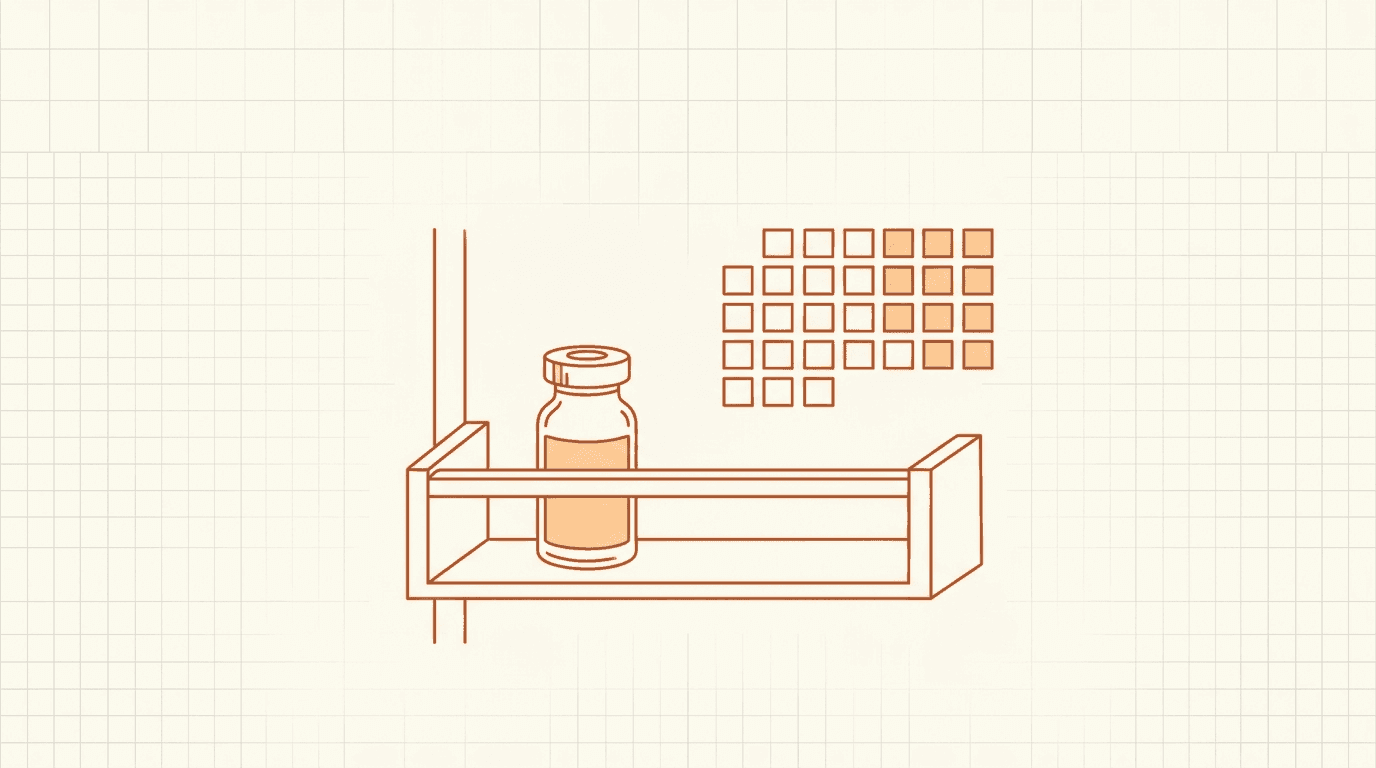
The safest pattern is to keep every peptide in its own reconstituted vial in the fridge and combine only in the seconds before you inject. Once water is added, peptides degrade through hydrolysis, oxidation, and aggregation; a pre-mixed, higher-concentration syringe sitting around gives all three more time and more opportunity. There is no upside to pre-mixing and a real shelf-life cost. Draw, check it is clear, inject, done.
Frequently asked questions
Does mixing peptides in the same syringe reduce effectiveness?
No. Drawing two compatible water-based peptides into one syringe is a delivery convenience: it saves a pin. It does not reduce, and does not boost, either peptide. Any synergy from a stack is biological (the two compounds acting in your body), not something that happens in the barrel. The one caveat from our knowledge base: keep the combined solution concentrated enough to dose accurately but no more diluted or concentrated than needed (reconstitute to the minimum volume that still lets you measure each dose on an insulin syringe), and combine at injection time rather than storing a pre-mixed syringe.
Can you mix BPC-157 and TB-500 in the same syringe?
Yes, this is the single most common peptide pairing, community-nicknamed the "Wolverine stack." Standard practice is to draw each from its own vial into one insulin syringe for a single subcutaneous injection. Separate vials are preferred over a pre-made blend so each peptide’s dose can be adjusted independently. Both are water-based, which is what makes co-drawing them straightforward.
Can you mix CJC-1295 and Ipamorelin together?
Yes. A GHRH analog (CJC-1295) plus a ghrelin mimetic (Ipamorelin) is the canonical growth-hormone-peptide pairing: it is frequently sold as a single blended vial and is routinely drawn from two vials into one daily subcutaneous shot. Both are water-based and dosed on the same daily cadence. One note: the long-acting "DAC" version of CJC-1295 is dosed weekly, so it is timed on its own rather than co-drawn with a daily peptide.
Can you mix a GLP-1 (semaglutide or tirzepatide) with peptides?
Keep GLP-1s (semaglutide, tirzepatide, retatrutide) in their own syringe. They are a separate medication class dosed once weekly with precise, titrated volumes (a different cadence from the daily peptides above), so there is no practical reason to co-draw them, and combining them only muddies your dosing. Run a GLP-1 as its own injection.
Can you mix testosterone with peptides in one syringe?
No. Injectable testosterone is oil-based (the hormone is suspended in a carrier oil) while reconstituted peptides are water-based. Oil and water do not form a usable single solution in the barrel, and the two have different injection characteristics. Keep water-based peptides and oil-based injectables in separate syringes. (Two oil-based compounds are a different story: our knowledge base notes oils combine with oils in one syringe with no chemical interaction; swap to a fresh needle before injecting.)
How long can mixed peptides sit before injecting?
Combine at injection time and inject promptly. Do not pre-mix a syringe to store. Once water is added, peptides are already time- and temperature-sensitive (our knowledge base flags hydrolysis, oxidation, and aggregation as the degradation pathways), and a higher combined concentration in a single draw raises aggregation risk. Mix right before you inject, then refrigerate each source vial separately.
Which peptides should never be combined in the same syringe?
The clearest documented example in our knowledge base: GHK-Cu and glutathione. A user reported the solution turning milky white mid-injection when the two were combined (a precipitation reaction), so keep those strictly separate. The general rules that prevent this class of problem: never cross the water/oil line (no water-based peptides with oil-based testosterone), keep GLP-1s on their own, and if you have not confirmed two compounds are compatible, give them separate pins.
Sources, and what nobody can tell you
- The volume arithmetic is definitional and it is the part that is genuinely knowable: drawing two compounds into one barrel adds their volumes, and each keeps the concentration it had in its own vial. See the blended-vial math for the case where they share a vial instead.
- Chemical compatibility is the part that is not knowable. Whether two research peptides remain stable in contact with each other in a barrel has not been studied for the combinations people actually use. Compatibility testing exists in hospital pharmacy for approved injectables precisely because contact time, pH and excipients can matter, and no equivalent body of work exists here. That is why drawing each from its own vial and injecting promptly is the cautious default, rather than pre-mixing and storing.
- Related: pH is one of the main drivers of peptide stability, and bacteriostatic water's own permitted pH range spans 4.5 to 7.0, so two compounds can meet in a barrel at a pH neither was formulated for. More on that in the storage post .
This is educational information, not medical advice: protocol decisions belong with your prescribing physician.

Written by
Jason Jeffries
Founder of Stackeddd. Data analytics by day (12 yrs), training for 20, juggling a full-time job, family, and app development. I run TRT and peptides myself, and I built Stackeddd because my whole tracking system was a notebook in a drawer in my bathroom. I’m not a doctor and none of this is medical advice.
STACKEDDD
Track it instead of guessing.
Doses, bloodwork, and an AI coach grounded in your own data — free to start, on the App Store and Google Play.