Reconstituted Peptides: How Long They Actually Stay Good in the Fridge
I bought a 30mg vial before doing the math, then spent months wondering if it would still work by the time I finished it. The number everyone quotes turns out to be measuring the water, not the peptide.
By Jason Jeffries · July 29, 2026
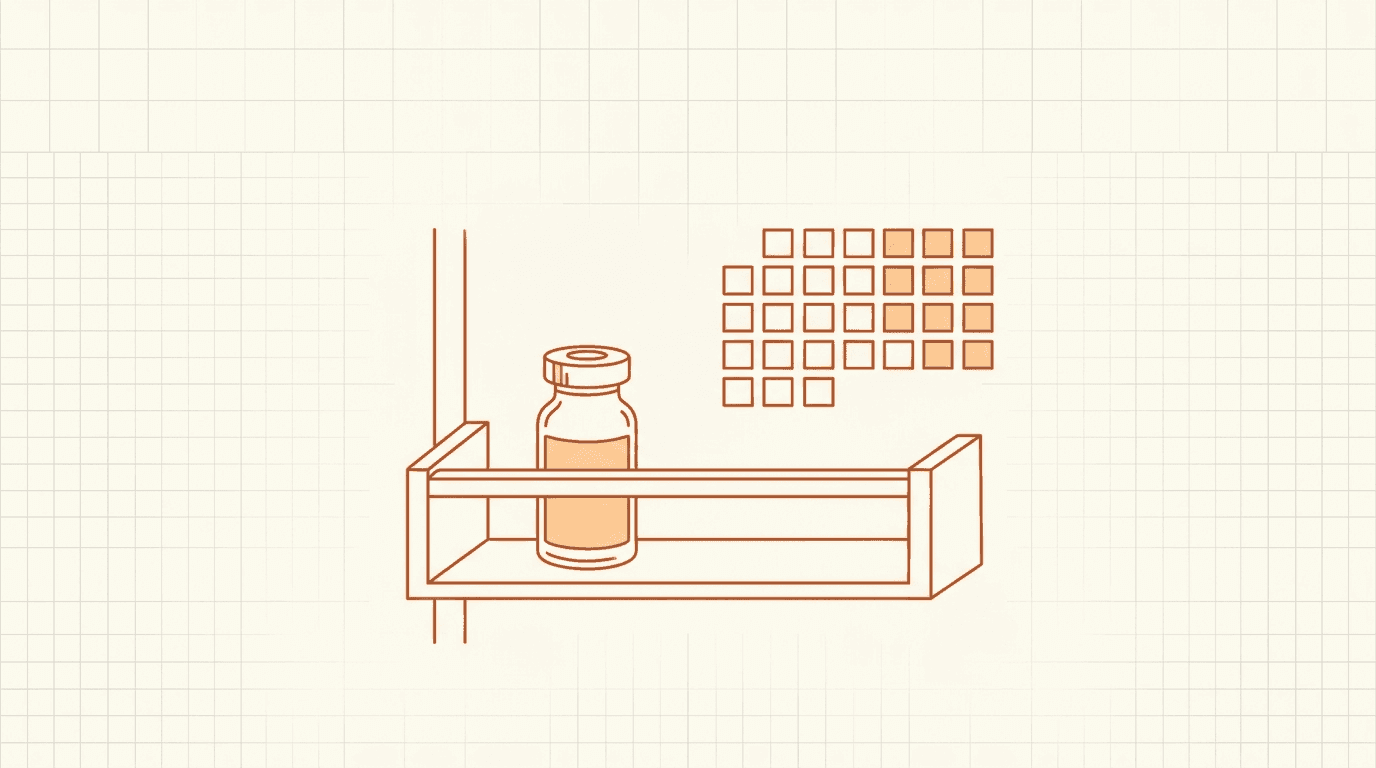
When I started retatrutide I was titrating up slowly, from half a milligram a week to two milligrams a week over about three months. I bought a 30mg vial to do it with, which I picked before I had done any of the arithmetic. If you run that math, and I eventually did, a 30mg vial at those doses is going to sit reconstituted in my fridge for a very long time. Months.
So I had a question I could not answer: was it still going to be any good by the time I got to the bottom of it? Not whether it would grow something. Whether it would still work.
I searched for that answer the way everybody does, on the message boards, and what I got back was a range from six weeks to six months before a peptide starts losing potency. Six weeks to six months. That is not an answer, that is a shrug with numbers attached. I used the vial and hoped.
I went back to that question properly this time, and the thing I found is that the number most often quoted at people asking it is real, but it is not measuring potency at all.
The 28-day figure behind “3 to 4 weeks” comes from USP General Chapter <797>, which sets a beyond-use date of 28 days for an opened multi-dose container that contains an antimicrobial preservative. It is a limit on the preservative, not a measurement of the peptide. For research peptides there is no published stability data at all. Where real data does exist, for approved peptide drugs, the windows range from 28 days refrigerated to 56 days at room temperature.
Where the 28 days actually comes from
USP <797> is the standard governing compounded sterile preparations. Its rule for multi-dose containers is specific: the beyond-use date for an opened or entered multiple-dose container with antimicrobial preservatives is 28 days, unless otherwise specified by the manufacturer.
Read what that sentence is about. It is about a container that has been punctured, and a preservative that is holding back bacterial growth across repeated punctures. It is a microbiology rule. It describes how long you can keep sticking a needle into the vial before contamination becomes the concern.
It says nothing whatsoever about whether the molecule dissolved in that water is still the molecule you paid for. Bacteriostatic Water’s own labeling carries the same 28-day discard after first puncture, which makes the point cleanly: that number belongs to the water. It got attached to the peptide somewhere along the way, and now it is repeated as though somebody measured it.
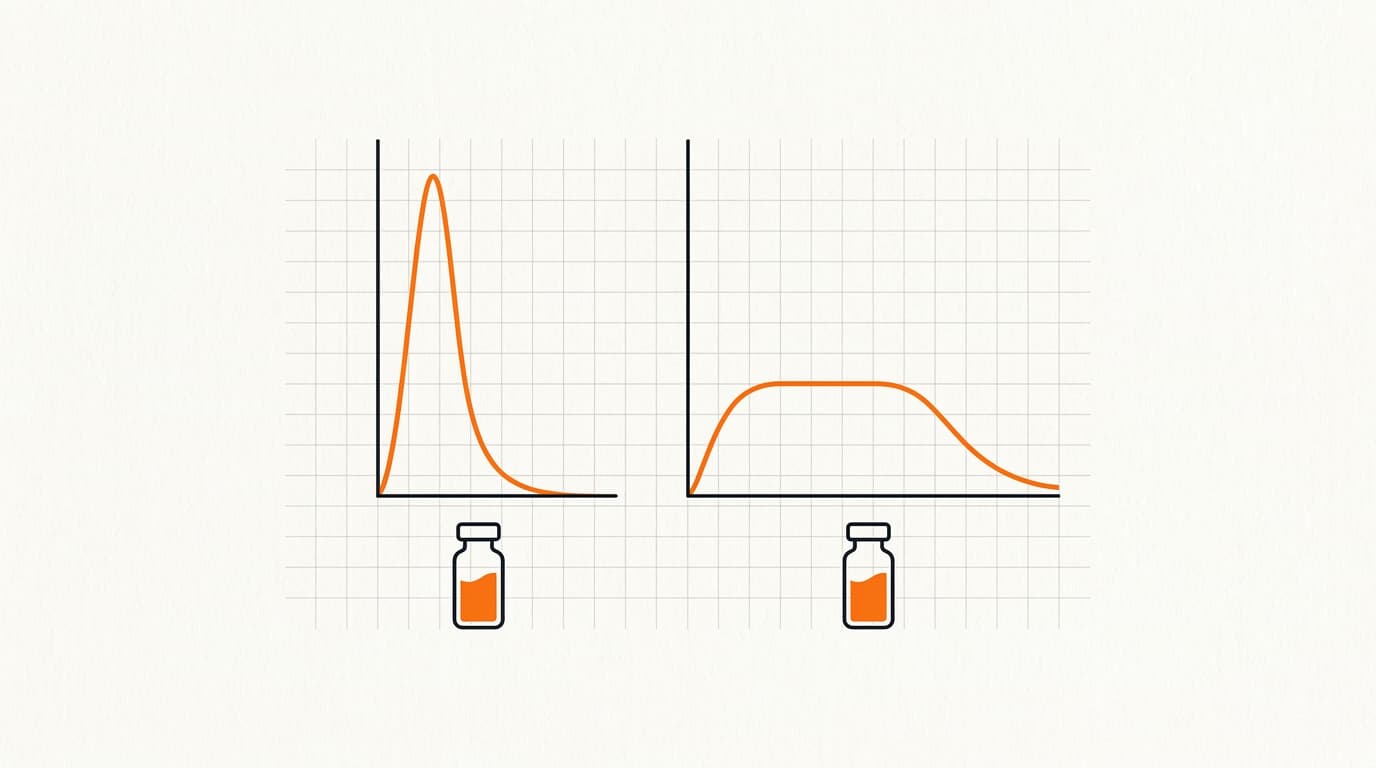
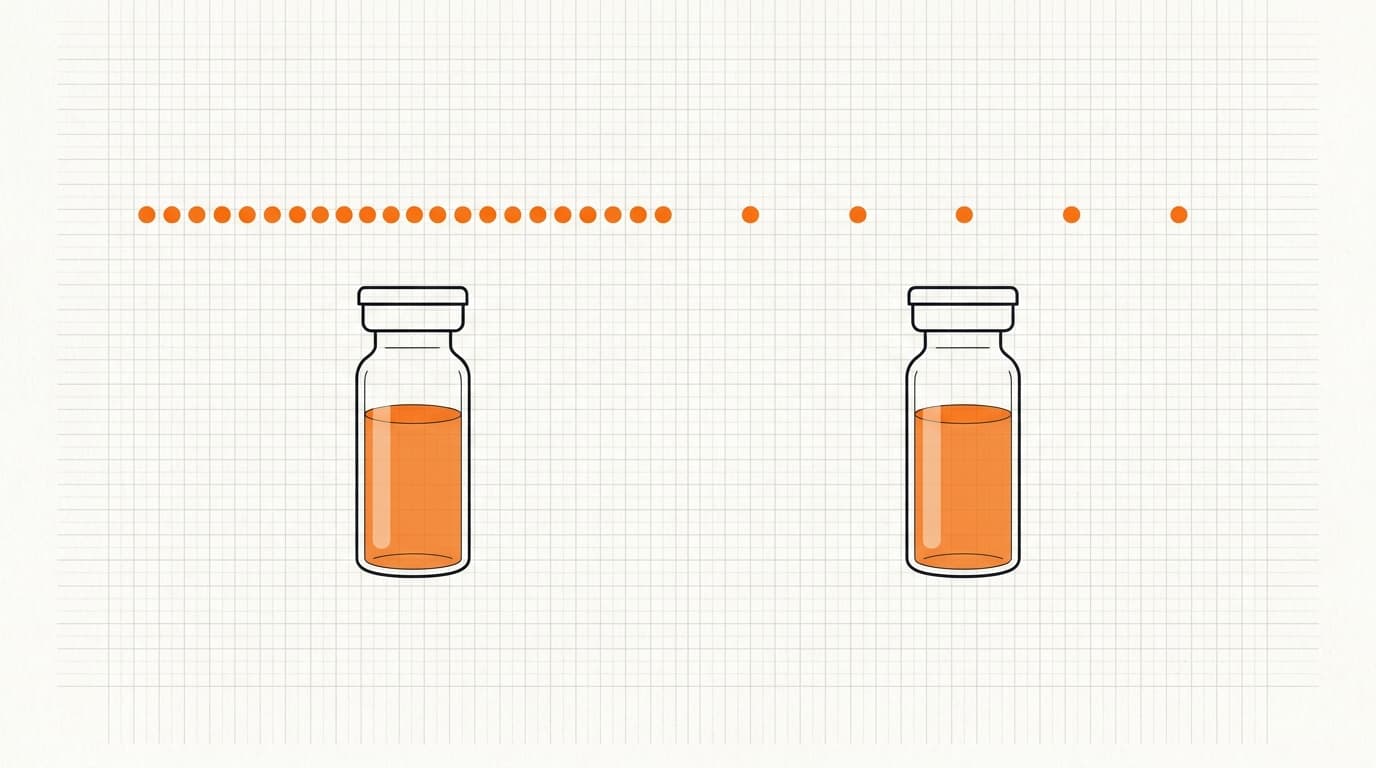
There are two clocks running on a reconstituted vial. One is microbiological, and it has been studied. The other is chemical, and for research peptides it has not.
How long is the powder good for?
Dry, the peptide is in much better shape, and the reason is simple: hydrolysis needs water and there is not any. Every degradation route that runs the clock on a mixed vial is either slowed dramatically or switched off entirely while it is a solid.
Here is the part that surprised me. Tesamorelin is sold as an approved drug, and the label instruction for the unmixed vial is to store it at room temperature, 20 to 25°C, in its original box to keep the light off it. Not refrigerated. Not frozen. Room temperature, with a multi-year expiry date on the box.
Plenty of people freeze their powder, and for research peptides the figures in circulation are one to three years at −20°C and longer at −80°C. Those come from the same sort of sources that could not agree about BPC-157, so weigh them accordingly, but the direction is not controversial: colder and drier is better, and the powder is the resilient form. Personally I do not freeze mine. They go in the refrigerator, which sits between the two and has never seemed like the thing worth optimising.
What bacteriostatic water actually buys you
Bacteriostatic Water for Injection is sterile water containing 0.9% benzyl alcohol (9 mg/mL) as a bacteriostatic preservative, supplied in a multiple-dose container from which repeated withdrawals can be made. Some presentations use 1.1%.
That preservative is the entire reason a multi-use vial is reasonable at all, and it is why plain sterile water, which has no preservative, gets treated as a single-use mix. But notice what benzyl alcohol does and does not do. It suppresses bacterial growth. It has no effect on hydrolysis, oxidation or deamidation, which is the chemistry that actually takes a peptide apart. BAC water protects you from what might grow in the vial. It does not protect the peptide from itself.
What actually degrades a peptide in solution
This part is well characterised in the formulation literature, even if the specific numbers for specific research peptides are not. Peptides in aqueous solution break down through a handful of known routes:
Hydrolysis, where water cleaves the peptide backbone, is one of the main pathways and depends strongly on pH. Deamidation of asparagine and glutamine can proceed considerably faster than backbone hydrolysis; the Asn-Gly sequence is the most labile, and the rate climbs as you move from acidic toward alkaline. Oxidation hits cysteine, histidine, tryptophan and tyrosine side chains, and is catalysed by trace transition metals or accelerated by light. On top of the chemistry there is physical instability: adsorption, aggregation and precipitation, which change nothing covalently but still ruin the product.
The practical upshot: pH matters as much as temperature. Peptides are generally most stable in mildly acidic conditions, roughly pH 3 to 5, where deamidation is slow. That is a large part of why two peptides in two different formulations can have genuinely different shelf lives under identical refrigeration, and it is why “keep it cold” is an incomplete answer.
Cold, dark, and undisturbed
Refrigeration at 2 to 8°C (36 to 46°F) is what every approved peptide drug label I checked specifies for a reconstituted or in-use product. Cold slows the chemistry above; it does not stop it. Worth knowing that cold is not uniformly protective, since dissolved oxygen concentration is actually higher in cold aqueous solution.
Light is a real and specific risk rather than a vague one. Photo-oxidation affects peptides containing aromatic residues, tryptophan, tyrosine and phenylalanine, or a disulfide bond, via photoionisation and singlet-oxygen formation. Oxytocin, for one, is documented as UV-sensitive. If a peptide contains those residues, an amber vial or simply keeping it out of the light is doing something measurable.
Heat accelerates hydrolysis, and β-elimination becomes a factor at high temperature combined with high pH. A warm car or a gym bag is genuinely worse than a fridge door.
Freezing after reconstitution is where I have to be careful, because this is one of the claims I could not fully support. The literature says stress conditions including freezing, heating and agitation may induce aggregation, so freezing a solution carries real risk. But the very specific and very confident claim you see everywhere, that repeated freeze-thaw cycles are uniquely destructive to peptides, is not something I could trace to a study. Pick one storage approach and stay with it. That is sensible on general principles. The precise numbers attached to freeze-thaw are not evidence.
What real stability data looks like when it exists
Two approved peptide drugs, both with published labeling, both stored after first use or reconstitution:
| Product | Labeled in-use storage |
|---|---|
| Somatropin, reconstituted (Humatrope, Genotropin) | 28 days, refrigerated 2–8°C |
| Semaglutide, after first use (Ozempic) | 56 days, refrigerated OR 15–30°C |
| Research peptides (BPC-157, TB-500, etc.) | No published data |
That is a two-fold difference in duration and a completely different temperature requirement, between two peptide drugs, both with real stability programmes behind them. One of them is fine on a kitchen counter for eight weeks. The other needs a fridge and gets half the time.
If two well-characterised peptides differ that much, the idea that a single number covers every research peptide was never plausible. And the third row is the honest one.
One peptide, two labels
Tesamorelin is sold in two presentations by the same manufacturer. One says use it immediately and throw the rest away. The other gives you seven days. I first wrote this section up as the cleanest proof of everything above, then read the two labels properly side by side and had to take most of it back.
| Mixed with sterile water | Mixed with bacteriostatic water | |
|---|---|---|
| Vial | 2 mg, one dose | 11.6 mg, seven daily doses |
| Powder stored at | Room temp, 20–25°C | Room temp, 20–25°C |
| After mixing | Use immediately, discard | 7 days |
| Stored at, once mixed | Do not refrigerate or freeze | Room temp. Do not freeze |
| Stabiliser in the formulation | None | Hydroxypropyl betadex |
The water is not the only thing that changed, which is where my first draft of this section went wrong. The single-dose version is tesamorelin with mannitol, sucrose, histidine and a trace of polysorbate. The seven-day version is built differently: it carries hydroxypropyl betadex, a cyclodextrin. That is a ring-shaped sugar molecule with a cavity a peptide can sit inside, shielding the parts of it that would otherwise be exposed to the water around them. It is in there deliberately, so that the product could survive a week out of the fridge.
The seven days is not a measurement of when tesamorelin falls apart either. The vial holds 11.6 mg, you draw 0.16 mL a day, and the label says one vial provides doses for seven consecutive days. The discard date lands exactly where the vial empties. Nothing on that label says the drug degrades on day eight, and there was never a reason to test that far, because by then there is nothing left to inject.
So the honest reading is narrower than the one I wanted. Seven days is a floor, not a ceiling, on a specific engineered formulation, held at room temperature rather than in a fridge. It tells you nothing about tesamorelin in a research vial, which is not that formulation and does not come with that testing behind it. If you run tesamorelin and have never seen a seven-day figure anywhere, that is why.
What the two labels do show is the thing this post keeps running into. Even here, written by the company that ran the stability programme, with real data behind it, the in-use number is describing the formulation and the size of the package. Not the molecule.
The BPC-157 problem
BPC-157 is the peptide people ask about most, so I went looking specifically for its stability data. I did not find any. Not a single independent, peer-reviewed stability study.
What I found instead was a set of confident numbers on sites that sell peptides, and those numbers do not agree with each other. Two to four weeks. Four to six weeks. Twenty-eight days. All stated plainly, none sourced, all from vendors.
I want to be precise about what that does and does not mean. It does not mean BPC-157 is unstable, and it does not mean those numbers are wrong. It means nobody has published the measurement, and the figures circulating come from parties with an obvious interest in the answer. The same applies to TB-500 and essentially every other research peptide.
This is a pattern. While researching an earlier post on growth hormone I turned up four peptide studies in circulation that do not exist at all, two of them quoting an identical fabricated result. Vendor-written content is the dominant source of information in this space, and this is what it is worth.
It also explains the six-weeks-to-six-months answer I got off the message boards years ago. Nobody there was lying to me. They were guessing, because there was nothing to look up, and there still is not.
Signs a vial has probably gone off
Aggregation and precipitation are documented physical instabilities, and they are the ones you can actually see. A peptide solution is expected to stay clear and colourless, or whatever colour it was when mixed. Cloudiness, visible particles, or a colour change means something has happened, whether contamination or the peptide falling apart, and that vial is not worth using regardless of how many days are notionally left on it.
The reverse is not true, and this is the uncomfortable part. A vial that looks perfectly clear can still have degraded, because hydrolysis and deamidation do not necessarily change the appearance of anything. Clear is not proof of intact. It is only proof that the obvious failure has not happened.
When a vial goes cloudy and gels up
This one comes up constantly, tesamorelin especially: a vial turns cloudy, then so viscous it barely moves when you tilt it. What you are looking at is aggregation, one of the documented physical instabilities, and it is pH-sensitive.
Watch what happens in those threads, though, because it is the whole problem in miniature. The advice converges on a brand of bacteriostatic water. Buy the good stuff, buy the one everybody uses, your water is the issue. Somebody suggests adding acetic acid to correct the pH, somebody else confidently replies that acetic acid raises pH, which is backwards, it is an acid. Someone states the pH scale runs 0 to 10. It runs 0 to 14. And a few people report that when a vial gels they shake it back into solution and keep using it, which does not undo anything chemically. It just removes the one visible signal that something went wrong.
Two things are actually true here and neither is a brand. First, the pH of bacteriostatic water is not a fixed number. The USP product runs about pH 5.7, with a permitted specification range of 4.5 to 7.0. That is roughly a 300-fold spread in hydrogen-ion concentration between the two ends, and both ends are entirely compliant, legitimate water. Buying a particular brand does not hand you a specific pH; the spec is simply wide. For a peptide that happens to be fussy about pH, that alone can be the difference between two vials behaving differently, with nobody doing anything wrong.
Second, and this is the part the threads keep missing: both approved presentations of tesamorelin are stored at room temperature once mixed, 20 to 25°C, and the single-dose one says in as many words not to refrigerate the reconstituted solution. People reporting gelling are usually keeping theirs in the fridge.
I want to be careful about how far that carries, because it is a different formulation from a research vial and I cannot tell you the instruction transfers. It is a lead, not an answer. But it is a good lead, and it costs nothing to try: the company that ran the stability programme on this exact molecule concluded the mixed product belongs on a counter, and the threads have spent years arguing about which brand of water to buy instead.
Do not shake a vial to dissolve it, either. Agitation is listed alongside freezing and heating as a stress that can induce aggregation. Swirl it, or just give it overnight in the fridge like I do.
We are probably too precious with this stuff
This is my opinion rather than a finding, but the research made me more confident in it, not less. There is an enormous amount of anxious ritual around these compounds: keep it out of any light, never let it warm up, do not jostle it, treat every vial like it is made of glass. The last one is true. Some of the rest is real. A lot of it is inherited.
The labels are a useful corrective. An approved peptide drug in powder form sits at room temperature for years. A reconstituted one sits at room temperature for a week, or eight weeks in the case of semaglutide. The manufacturers who actually ran the stability studies are, on several points, noticeably more relaxed than the message boards are.
The genuinely evidenced cautions are narrower than the folklore, and they are the ones that show up in writing: keep light off the ones with aromatic residues, do not freeze a solution, do not shake it, and respect a specific manufacturer’s number when one exists. Most of the rest is people being careful in the absence of information, which is understandable, and then repeating it to each other as though it were information, which is where it goes wrong.
I want to be fair to the caution, though, because the argument cuts both ways. Nothing about how a research peptide reaches you is precious, and it is tempting to conclude from that it must all be fine. That is not what it shows. It shows that nobody measured it. “It probably still works” and “nobody has checked” feel like the same sentence and they are not.
This is the mistake I made: I picked the vial before working out how long it would take me to finish it. The free Dosing Calculator (Peptides tab) runs vial size, water volume and per-draw math together, so you can see how many weeks a given vial is actually going to sit in your fridge before you buy it. If you are combining compounds in one vial rather than storing them separately, the blended-vial math and the same-syringe mixing guide cover the compatibility questions that sit on top of the storage question.
So what do I actually do
Mechanically, not much. I reconstitute a vial, put it straight in the refrigerator so the powder has overnight to dissolve properly, and start using it the next day. Every vial I have lives in the fridge. I know a vial is done when it is empty. I have never written a date on one.
Whether that 28-day mark ever comes up for me depends entirely on the compound and the vial size, and the spread is bigger than you would think. A small vial I go through in under a week never gets anywhere near it. That 30mg retatrutide vial, now that I am at six milligrams a week, takes about five weeks to empty, which puts it past 28 days every single time.
The one thing that did change is what I buy. I now try to buy vial sizes that closely match the protocol I am actually running. I do not want a reconstituted vial sitting in my fridge for six months, and it is not because I think it will lose its potency. It is because I do not know, nobody has published it, and I might as well err on the side of caution when I have the option.
That is the whole takeaway, and I notice it is the opposite of what anyone selling peptides has an interest in telling you. And when a product comes with its own stability data from someone who actually tested it, that beats every general rule on this page, including mine.
Frequently asked questions
How long do reconstituted peptides last in the fridge?
Honestly: for research peptides, nobody has published the answer. The "3 to 4 weeks" figure in circulation traces to USP General Chapter <797>, which sets a 28-day beyond-use date for an opened multi-dose container that contains an antimicrobial preservative. That is a limit on how long the preservative can be trusted to hold back bacterial growth, not a measurement of whether the peptide is still intact. Those are two different clocks, and only one of them has been measured.
Does reconstituted BPC-157 expire?
It degrades, yes. What I cannot tell you is how fast, because I could not find a single independent stability study for it. Every number I found came from a site selling peptides, and they do not agree with each other: 2 to 4 weeks, 4 to 6 weeks, and 28 days all appear as confident claims. When the only sources are sellers and the sellers contradict each other, the correct answer is that the figure is unknown.
What is the ideal peptide storage temperature?
Dry, lyophilized peptide keeps best cold and dry, because hydrolysis needs water and there is none. Once reconstituted, 2 to 8°C (36 to 46°F) is what every approved peptide drug label specifies. Worth knowing that cold is not automatically better in every respect: dissolved oxygen is higher in cold aqueous solution, which is why refrigeration slows breakdown rather than stopping it.
Why does bacteriostatic water matter for storage, not just mixing?
Bacteriostatic Water for Injection is sterile water with 0.9% benzyl alcohol (9 mg/mL) added as a preservative, supplied specifically as a multiple-dose container. The benzyl alcohol is what makes repeated draws from one vial reasonable. It is a preservative for the solution, not a stabilizer for the peptide: it does nothing about hydrolysis, oxidation or deamidation, which are the chemistry that actually breaks a peptide down.
Can I refreeze a peptide after it has been reconstituted?
The formulation literature says stress conditions including freezing, heating and agitation may induce aggregation, so freezing a peptide already in solution carries a real risk. What I want to be straight about is that the specific claim you see everywhere, that repeated freeze-thaw cycles are especially damaging, is not something I could source to a study on peptides. Picking one storage approach and sticking to it is sensible; the confident numbers attached to freeze-thaw are not.
Does it matter if the vial sits at room temperature?
It depends entirely on the peptide, and the common claim that room temperature cuts the window to days is not true as a general rule. Ozempic’s labeling allows the pen to be stored for 56 days at controlled room temperature (15 to 30°C) after first use. That is a peptide drug explicitly labeled for eight weeks unrefrigerated. Formulation, pH and the specific sequence matter more than any blanket rule about temperature.
Sources
- USP General Chapter <797>, Pharmaceutical Compounding — Sterile Preparations (multi-dose container beyond-use dating). USP. The relevant sentence: the beyond-use date after initially entering or opening a needle-punctured multiple-dose container is 28 days.
- Bacteriostatic Water for Injection labeling (0.9% benzyl alcohol, multiple-dose container). DailyMed.
- Designing Formulation Strategies for Enhanced Stability of Therapeutic Peptides in Aqueous Solutions: A Review (degradation pathways, pH, photo-oxidation, aggregation). PMC.
- EGRIFTA SV and EGRIFTA WR (tesamorelin) labeling — the two-presentation comparison, room-temperature storage, 7-day in-use period, pH 4.5–7.4. EGRIFTA SV and EGRIFTA WR.
- Bacteriostatic Water for Injection, Hospira labeling — pH 5.7, specification range 4.5 to 7.0. Pfizer.
- Ozempic (semaglutide) prescribing information, in-use storage. FDA.
- Humatrope (somatropin) prescribing information, reconstituted storage. Lilly.
This is educational information about storage, not medical or dosing advice. Somatropin and semaglutide are referenced here solely as published storage data for approved medications. Research peptides discussed here are not approved medications, and no independent stability data exists for them; when a product includes its own storage guidance from a party that tested it, follow that over any general figure on this page.

Written by
Jason Jeffries
Founder of Stackeddd. Data analytics by day (12 yrs), training for 20, juggling a full-time job, family, and app development. I run TRT and peptides myself, and I built Stackeddd because my whole tracking system was a notebook in a drawer in my bathroom. I’m not a doctor and none of this is medical advice.
STACKEDDD
Track it instead of guessing.
Doses, bloodwork, and an AI coach grounded in your own data — free to start, on the App Store and Google Play.