BPC-157 vs TB-500: Why One Needs Daily Dosing and the Other Doesn't
They get stacked together and talked about together, so it is easy to assume they are dosed together too. They are not. BPC-157 is a daily shot and TB-500 is twice a week. Here is the pharmacology that explains why, and why the difference is a feature of the stack, not a contradiction.
By Jason Jeffries · July 3, 2026
My own peptide use started right here: BPC-157 for a knee injury, about three years ago, followed later by TB-500. Working out why one needed a daily shot and the other did not is the same split this whole post explains.
Both clear from the blood fast, but they are dosed on opposite schedules. BPC-157 has a short half-life (~30 minutes) and acts largely locally: there is no depot, so infrequent dosing buys nothing and it is run daily (sometimes split twice). TB-500 also leaves the blood quickly, but its tissue-level cell-migration effect outlasts the compound in circulation and acts systemically, so 2–3×/week is enough. The biology does the smoothing. That gap between blood half-life and tissue effect is the whole reason the schedules differ.
Same stack, opposite schedules
BPC-157 and TB-500 are the two halves of the most common recovery peptide pairing, so they tend to get discussed as if they were interchangeable. Look at how people run them and the schedules split hard: BPC-157 gets pinned every single day, while TB-500 gets pinned two or three times a week. That is not sloppiness or personal preference. It falls out directly from how each one behaves once it is in you.
The key idea is the gap between two different clocks. One is the blood half-life: how fast the molecule itself is cleared from circulation. The other is the tissue effect: how long the biological signal the compound triggers keeps working after the molecule is gone. For BPC-157 those two clocks run at nearly the same speed. For TB-500 they come apart, and that gap is the reason.
BPC-157: short half-life, local action, no depot
BPC-157 is a synthetic 15-amino-acid peptide (Body Protection Compound-157) studied for tissue repair. Its half-life is short (on the order of 30 minutes), after which it is metabolized in the liver and cleared by the kidneys. Its mechanism appears to act locally, near where it is injected: preclinical work points to it upregulating VEGF (new blood-vessel growth) and engaging the FAK-paxillin pathway that helps fibroblasts migrate and rebuild tissue at a damaged site.
Put those two facts together and daily dosing is forced. Because BPC-157 cannot form a depot in the tissue the way an oiled testosterone ester does, a single infrequent dose does not buy you anything: it is present for a few hours and then gone, with no long tail to carry it to the next day. There is a small upside to that: timing is forgiving. A missed dose does not linger and an early one does not pile up. But the trade is that you have to show up every day (some people split the daily amount into a morning and an evening pin for steadier exposure).
TB-500: fast blood clearance, but the tissue effect outlasts it
TB-500 is a synthetic fragment of thymosin beta-4, a protein your body uses in tissue repair. It also leaves the blood relatively quickly. But here is the nuance that flips the schedule: its tissue-level effects outlast its blood half-life. Its signature mechanism is actin sequestration: by binding G-actin it promotes cell motility, helping repair-competent cells migrate toward damaged tissue. That signal, once set off, keeps working after the compound itself has cleared.
Two consequences follow. First, the action is systemic rather than local: the signal travels through the whole body, so it does not much matter where you place the injection, unlike a compound that works at the needle tip. Second, because the effect persists, a 2–3×-weekly schedule is enough. The biology does the smoothing for you instead of the dosing frequency having to do it. Loading-then-taper protocols lean on exactly this: you are building up tissue-level activity, not chasing a blood level.
The two dosing shapes, side by side
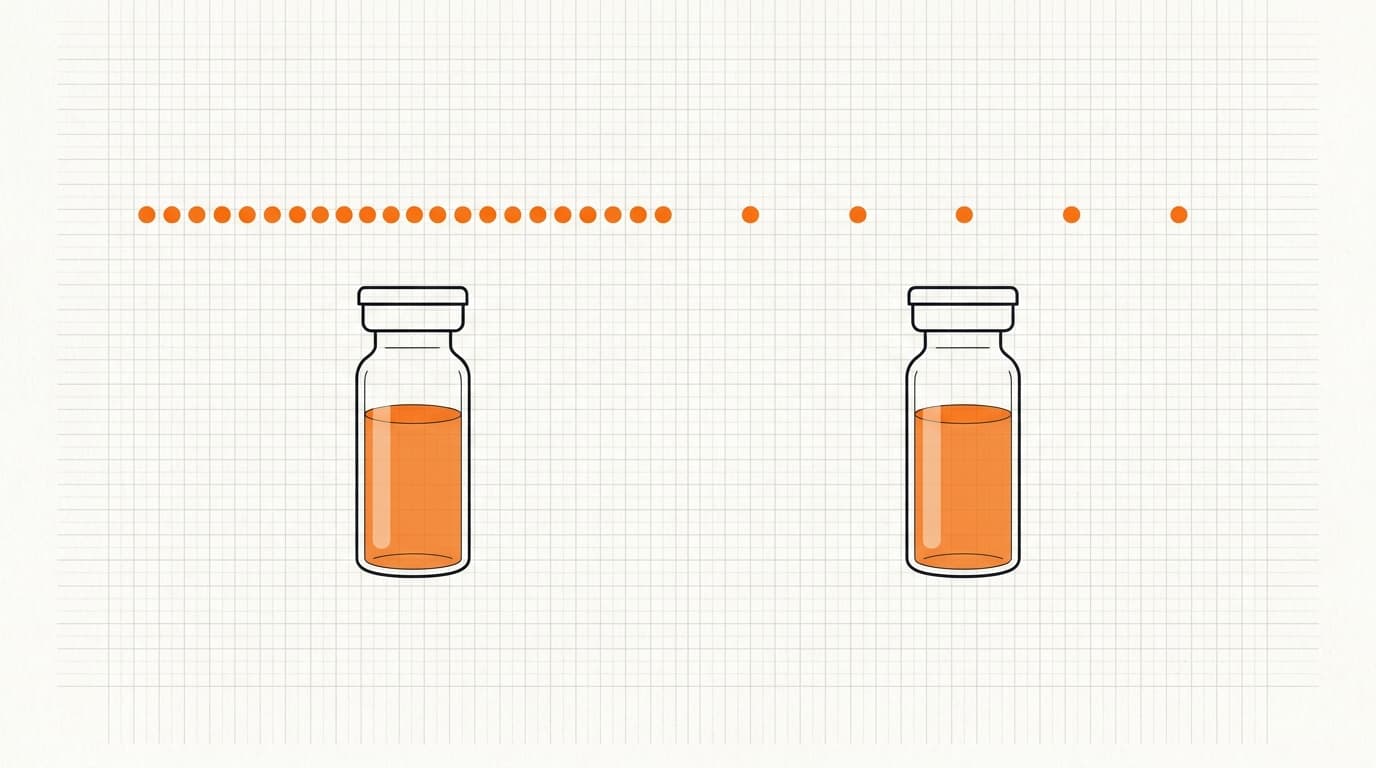
The chart below contrasts the pattern each one produces. BPC-157 is a series of sharp daily pulses that spike and clear with nothing left over, which is why the redose has to come every day. TB-500’s persistent tissue effect accumulates into a sustained band that stays elevated between shots, which is why a couple of doses a week hold it up. It is an illustration of the shape of the difference, not a measured concentration.
You can also see how a short-half-life peptide behaves day-to-day in the free Blood-Level Simulator. Change the half-life and dosing interval and watch whether anything carries over to the next day, which is the heart of the BPC-vs-TB-500 difference.
Side-by-side comparison
| Attribute | BPC-157 | TB-500 |
|---|---|---|
| What it is | 15-amino-acid peptide (Body Protection Compound-157) | Fragment of thymosin beta-4 (Tβ4) |
| Blood half-life | ~30 minutes | Short (hours) |
| Tissue-level effect | Tracks the blood level (clears with it) | Outlasts the blood level (persists after clearance) |
| Where it acts | Largely local (near the injection) | Systemic (site barely matters) |
| Typical frequency | Once (sometimes twice) daily | 2–3× per week |
| Why that frequency | No depot + fast clearance — infrequent dosing leaves gaps | Persistent tissue effect bridges the gap between doses |
| Evidence / status | Largely preclinical; not FDA-approved for human use | Largely preclinical; not FDA-approved for human use |
Why the “Wolverine stack” pairs them
The opposite schedules are the reason the two work well together. BPC-157 builds a favorable repair environment right where you inject it, and TB-500 mobilizes repair cells toward that area from the whole body. The mechanisms differ, the scopes differ, and so do the cadences, but the two turn out complementary rather than redundant: a daily local primer alongside a twice-weekly systemic recruiter.
Because of that, the common way to run them is not a pre-mixed blend but drawing each from its own vial into a single insulin syringe for one injection, so each dose can be adjusted independently. If you do want to combine them into one vial, the concentration and units math gets fiddly. That is its own topic, covered in blended peptide vials, and the syringe-sharing rules are in mixing peptides in the same syringe.
This post explains why the two are dosed differently, not whether you should use either. The healing evidence for both is overwhelmingly preclinical (animal and test-tube), neither is FDA-approved for human use, and both carry a pro-angiogenic caution that makes an active or recent cancer history a reason to talk to a doctor first. Any protocol is a conversation between you and your prescriber.
What this means for tracking
The two failure modes are different, so what is easy to lose track of is different too. With BPC-157 the risk is the daily streak: a dose every day is a lot of small events to remember, and the reconstitution math is where mistakes creep in since you are drawing small units constantly. With TB-500 the risk is “wait, was that Monday or Tuesday?” on a few-times-a-week cadence, plus knowing which phase of a loading-then-taper protocol you are in. In both cases, logging each shot with its site and the recovery marker you are chasing (pain, range of motion, gut symptoms) is what turns a fuzzy memory into a trend you can read. For the deeper pharmacology of each compound on its own, see the BPC-157 guide and the TB-500 guide.
My own run with these
BPC-157 helped a little, mostly with mobility, but nothing dramatic. Later I added TB-500 for what is often called the “Wolverine stack,” and it helped a bit more: more mobility, and I think it took the edge off some full-body inflammation too.
That is the honest version, modest and incremental. It is one data point, not a recommendation, for the reasons above.
Frequently asked questions
Why does BPC-157 need daily dosing?
BPC-157's half-life is short (on the order of 30 minutes) and it forms no depot in the tissue the way an oiled testosterone ester does. It is cleared within hours and nothing accumulates from day to day, so a less-frequent shot would leave long stretches with no compound present. Daily (sometimes split into morning and evening) is what keeps it around often enough to matter.
What is the half-life of TB-500?
Its blood half-life is short (on the order of hours), but its tissue-level effect persists noticeably longer than the compound stays in circulation. The cell-migration signal it sets off outlasts the molecule itself, which is why a twice-to-thrice-weekly schedule works and daily dosing is unnecessary.
Can you take BPC-157 and TB-500 together?
They are the classic pairing (often called the "Wolverine stack") because their mechanisms are complementary: BPC-157 tends to act locally to build a favorable repair environment, while TB-500 acts systemically to mobilize repair cells toward injured tissue. Community practice is to draw each from its own vial into one insulin syringe for a single injection, rather than pre-mixing a fixed-ratio blend, so each can be dosed on its own schedule. Whether any of this is appropriate for you is a physician conversation; the evidence is largely preclinical and neither is FDA-approved for human use.
How often do you inject TB-500 vs BPC-157?
On opposite cadences. BPC-157 is typically run once (sometimes twice) daily because it clears fast and does not accumulate. TB-500 is typically dosed only two to three times a week (commonly around 2–2.5 mg per shot for roughly 5 mg/week) because its tissue-level effect carries it between doses. Both are community-derived patterns, not settled medicine.
What is the Wolverine stack?
It is the informal name for running BPC-157 and TB-500 together for recovery, after the comic-book character known for rapid healing. The rationale is mechanistic: BPC-157 works largely at the injection site to encourage local tissue repair and blood-vessel growth, and TB-500 works body-wide to help repair-competent cells migrate toward the damage. Different mechanisms, different dosing schedules, meant to be complementary. As with either peptide alone, the human evidence is limited and it is not an FDA-approved therapy.
Sources, and the state of the evidence
Being exact about this matters more here than on most pages, because the gap between what is claimed for these two and what has been measured in a human is very wide.
- BPC-157: one human pilot study exists. Twelve women with interstitial cystitis, all of whom had already failed pentosan polysulfate, received BPC-157 injected around the inflamed area of the bladder during a single cystoscopy. Ten of twelve reported complete symptom resolution. Lee, Walker & Ayadi, Alternative Therapies in Health and Medicine, 2024. PubMed.
- What that study is not. It has no control group, no randomisation and no blinding; the outcome is the patient's own rating of her symptoms; and the peptide was placed directly at the lesion during a procedure rather than injected subcutaneously the way people actually use it. It is a signal worth following up, and it is not evidence that injecting BPC-157 under the skin repairs a tendon. Those are different questions.
- Everything else is preclinical. The healing literature for BPC-157 is substantial and it is almost entirely rodent work. For a current overview of that literature and its limits, see the 2025 narrative review on musculoskeletal healing. PMC.
- TB-500 versus thymosin beta-4. Thymosin beta-4 has been through human trials for indications that are not injury repair, which is a genuinely different thing from the injectable research compound sold as TB-500 having been tested for the use people buy it for. The combination of the two peptides has never been tested in humans, and has not been tested as a combination in animals either.
This is educational information, not medical advice. BPC-157 and TB-500 are research peptides that are not FDA-approved for human use; the healing evidence is largely preclinical and the dosing patterns described here are community-derived, not settled medicine. Decisions about whether, and how, to use either one belong with a qualified physician.

Written by
Jason Jeffries
Founder of Stackeddd. Data analytics by day (12 yrs), training for 20, juggling a full-time job, family, and app development. I run TRT and peptides myself, and I built Stackeddd because my whole tracking system was a notebook in a drawer in my bathroom. I’m not a doctor and none of this is medical advice.
STACKEDDD
Track it instead of guessing.
Doses, bloodwork, and an AI coach grounded in your own data — free to start, on the App Store and Google Play.