Blended Peptide Vials: The Math for Dosing Multiple Compounds From One Syringe
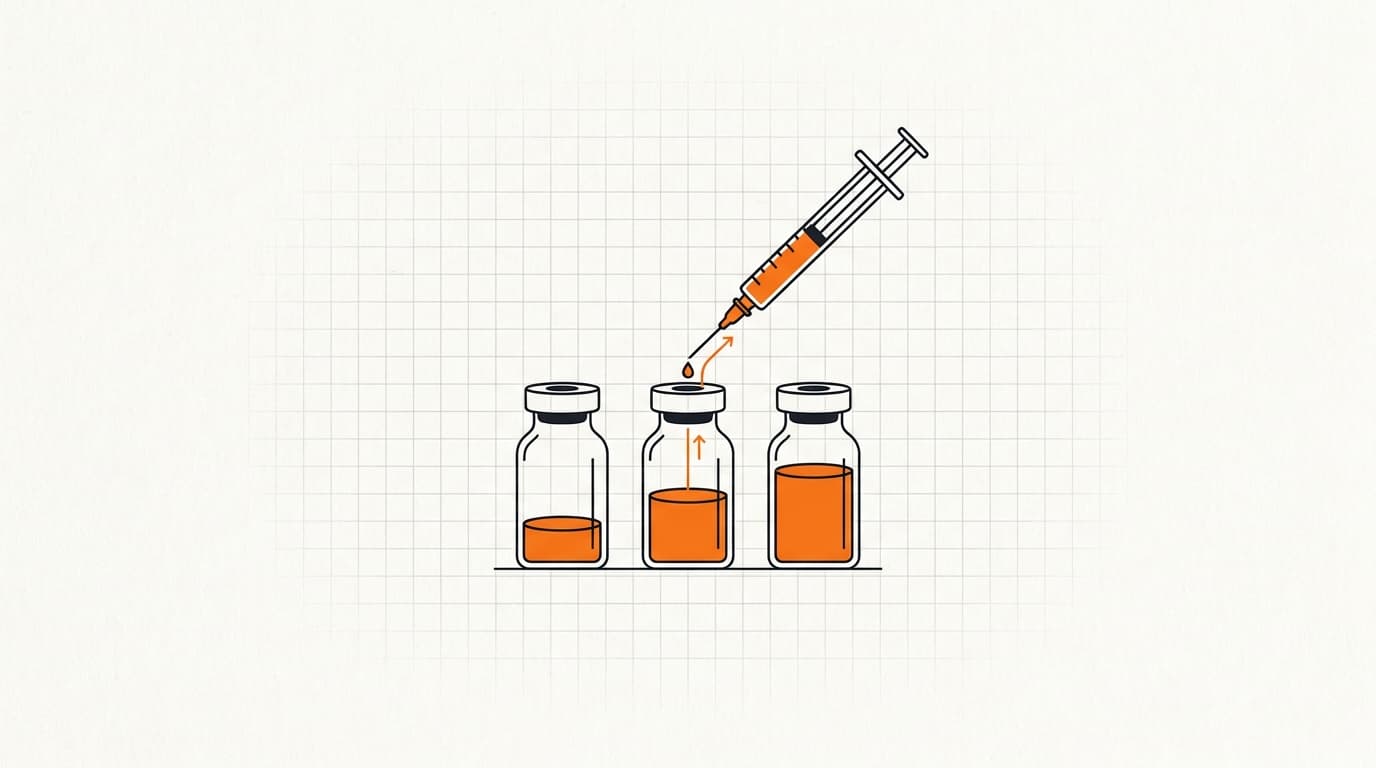
Reconstitute a blend and every compound in it gets its own mg/mL, so a single draw doses all of them at once, in the ratio the vial was built at. Here is the arithmetic, two worked examples, and why you cannot dial one compound up on its own.
By Jason Jeffries · July 3, 2026
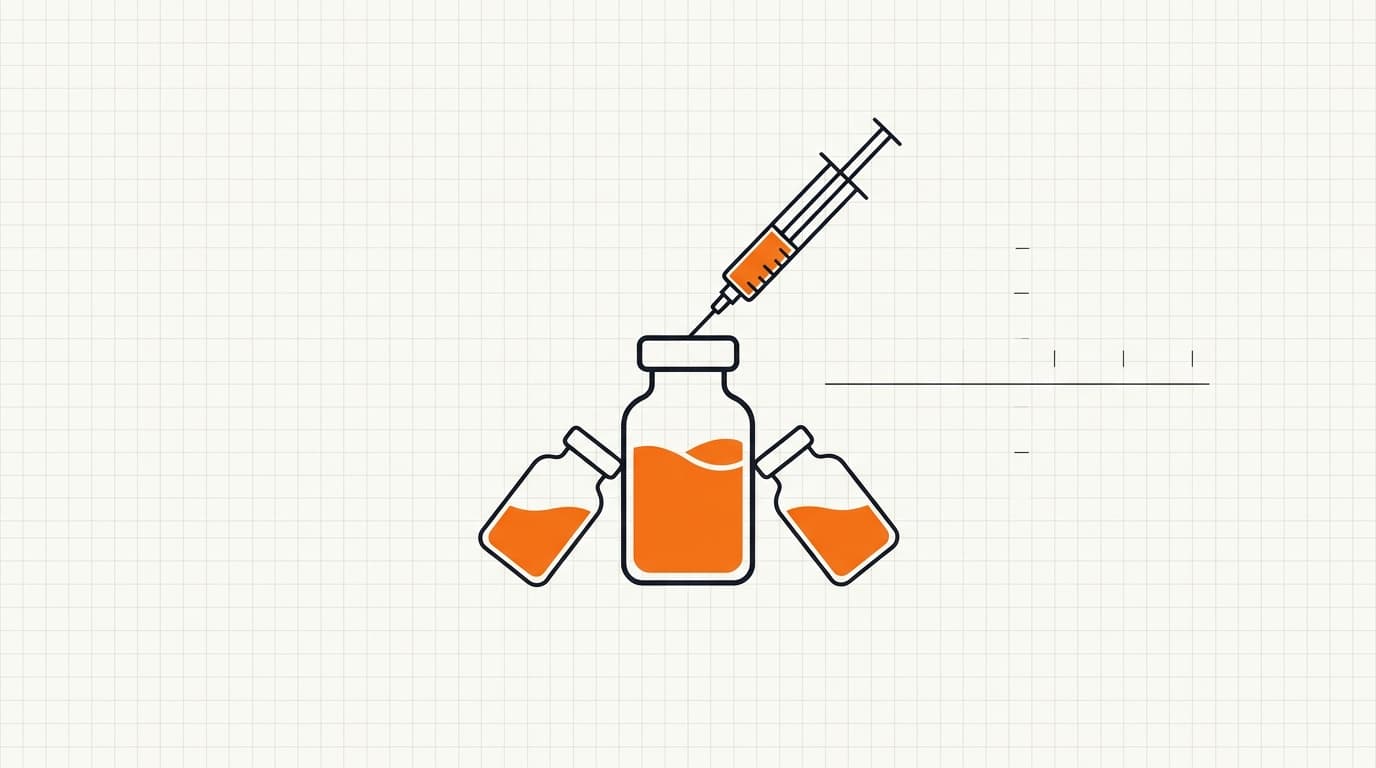
I've never mixed two compounds in one syringe myself. Every blend I've run came already mixed in the vial. But the per-compound math on a blend messed me up, especially with Glow: it's 50 mg of GHK-Cu, 10 mg of BPC-157, and 10 mg of TB-500, and the number printed on the vial is 70, which is the total of all three. Figuring out how much of each one I was drawing in a given dose tripped me up at first.
In a blended vial, each peptide has its own concentration = that peptide's mg ÷ total BAC water (mL). One draw of V mL then delivers V × each concentration, so a single draw doses every compound in the blend at once, in the fixed ratio the vial was made at. You cannot draw more of one compound and less of another from a pre-made blend. That ratio is locked by how the vial was manufactured.
What a “blended” vial actually is
A blend is a single vial the manufacturer filled with more than one peptide: a BPC-157 + TB-500 vial, a CJC-1295 + Ipamorelin vial, and so on. It arrives as one combined lyophilized (freeze-dried) cake, and you reconstitute the whole thing at once with bacteriostatic water, exactly like a single-compound vial.
This is the piece the bare blend calculators skip. They hand you one concentration number and leave you to wonder how much of each compound is in a draw. The answer is not one concentration: it is one per compound, and they all come out together in every draw.
The formula: each peptide gets its own concentration
Reconstitution is still one division (the same one from the single-compound reconstitution math), but in a blend you run it once for each compound, and they all share the same water:
Each compound's concentration = that compound's mg ÷ total BAC water (mL)
The water is common to the whole vial, so the compound with more milligrams ends up at a higher concentration, and the ratio between their concentrations is exactly the ratio of their milligrams. Then a single draw does the rest:
mcg of a compound per draw = volume drawn (mL) × that compound's concentration
Because you draw one volume, that same V multiplies every compound's concentration at once. There is no separate draw per compound: one plunger pull doses all of them.
Worked example: a BPC-157 + TB-500 blend
Take a vial holding 10 mg total, split evenly: 5 mg of BPC-157 and 5 mg of TB-500, and reconstitute with 3 mL of BAC water.
Start with the concentrations. The total, and then each compound on its own:
- Total: 10 mg ÷ 3 mL = 3.33 mg/mL
- BPC-157: 5 mg ÷ 3 mL = 1.67 mg/mL
- TB-500: 5 mg ÷ 3 mL = 1.67 mg/mL
The total concentration (3.33 mg/mL) is real, but it is not the number you dose from: each compound sits at 1.67 mg/mL, which is 1,667 mcg/mL of each.
Now draw 18 units on a U-100 insulin syringe, where 100 units equals 1 mL, so 18 units is 0.18 mL:
- BPC-157: 0.18 mL × 1.67 mg/mL = 0.30 mg ≈ 300 mcg
- TB-500: 0.18 mL × 1.67 mg/mL = 0.30 mg ≈ 300 mcg
One 18-unit draw delivers about 300 mcg of BPC-157 and 300mcg of TB-500, in the same shot. Because this vial is a 1:1 blend, the two doses are equal; if the split were uneven, they would differ — but they would still ride out on the same single draw.
You cannot independently adjust one compound in a pre-made blend. The ratio is locked by how the vial was manufactured. Adding more water lowers every concentration together; drawing a bigger volume raises every dose together. There is no draw size or water volume that gives you more BPC-157 without also giving you proportionally more TB-500. To change the ratio you need a different vial, or you mix your own from separate vials, where you set the ratio yourself.
A second example: an uneven three-way blend
The formula does not care how many compounds are in the vial or whether the split is even. Take an illustrative three-way blend: 2 mg CJC-1295, 5 mg Ipamorelin, and 3 mg Sermorelin, for 10 mg total, reconstituted with 2 mL of BAC water. Run the one division per compound:
- CJC-1295: 2 mg ÷ 2 mL = 1 mg/mL (1,000 mcg/mL)
- Ipamorelin: 5 mg ÷ 2 mL = 2.50 mg/mL (2,500 mcg/mL)
- Sermorelin: 3 mg ÷ 2 mL = 1.50 mg/mL (1,500 mcg/mL)
Now a single 20-unit (0.20 mL) draw delivers all three at once:
- CJC-1295: 0.20 mL × 1 mg/mL = 200 mcg
- Ipamorelin: 0.20 mL × 2.50 mg/mL = 500 mcg
- Sermorelin: 0.20 mL × 1.50 mg/mL = 300 mcg
The doses come out 200 / 500 / 300 mcg, the same 2:5:3 ratio the vial was filled at. That is the general rule: the per-draw doses always hold the manufactured ratio, no matter the draw size. (The milligram figures here are purely to show the arithmetic, not a recommended blend or protocol.)
Reference table: one blend, draw size to mcg of each compound
For the 5 mg + 5 mg blend in 3 mL above (1.67 mg/mL of each compound), here is what each draw delivers. Because it is a 1:1 blend, both compounds land on the same number, which is exactly the point: pick a draw, read both doses at once.
| Draw (units) | Volume (mL) | BPC-157 per draw | TB-500 per draw |
|---|---|---|---|
| 6u | 0.06 mL | 100 mcg | 100 mcg |
| 12u | 0.12 mL | 200 mcg | 200 mcg |
| 18u | 0.18 mL | 300 mcg | 300 mcg |
| 24u | 0.24 mL | 400 mcg | 400 mcg |
| 30u | 0.30 mL | 500 mcg | 500 mcg |
| 36u | 0.36 mL | 600 mcg | 600 mcg |
Change the water and every row shifts together. Add 4 mL instead of 3 mL and each concentration drops, so the same 18-unit draw delivers less of both compounds, but the two are still equal, because the water is shared.
You can run your exact blend through the free Blend tab of the Dosing Calculator: enter each compound's mg and your BAC water, and it returns the per-compound mcg for any draw, no app or account needed.
Where it got me
That Glow mix-up is why I sat down and worked out the formula above: one concentration per compound, not one number for the whole vial. I built the Blend tab in the Stackeddd app to run the same arithmetic for you, so the numbers you see when you log a dose match what you would work out by hand.
Frequently asked questions
How do you calculate the dose of each peptide in a blend?
Each peptide gets its own concentration: that peptide’s milligrams in the vial divided by the total bacteriostatic water you added. Then any single draw delivers the volume you draw multiplied by that peptide’s concentration. Do it once per compound in the vial and a single draw gives you the mcg of every one of them at the same time.
Can you adjust one peptide in a pre-made blend?
No. The ratio between the compounds is locked when the vial is manufactured, and reconstitution does not change it: adding more or less water scales every compound together, up or down, but never one relative to another. If you want more of one compound and less of another, you need a differently-made vial, or you mix your own from separate single-compound vials.
Is a blend the same as mixing two peptides in a syringe yourself?
Not quite. A pre-made blend is a single vial the manufacturer already combined at a fixed ratio, so you cannot change how much of each you get per draw. Mixing your own means combining separate single-compound vials, where you set the ratio and can adjust each one independently. The math and the tradeoffs are covered in the mixing-two-peptides post.
How much BAC water should I add to a blended vial?
The same choice you make for any vial — there is no fixed rule. Total concentration is the total milligrams of everything in the vial divided by the water you add; more water means a lower concentration and a larger, easier-to-measure draw, less water means the reverse. The blend part does not change this; it means every compound scales together with your water choice.
How many mcg of each peptide am I getting per draw?
For each compound, multiply the volume you draw (in mL) by that compound’s concentration (its mg divided by the total water). A 0.18 mL draw from a vial holding 5 mg of a compound in 3 mL of water delivers 0.18 × 1.67 mg/mL ≈ 0.30 mg, or about 300 mcg of that compound, and the same draw delivers every other compound in the vial in one shot.
Can Stackeddd do this math for me?
Yes. The Blend tab of the Dosing Calculator takes each compound’s mg and your total BAC water and returns the per-compound mcg for any draw automatically. That is the same engine built into the Stackeddd app, so the numbers match what you see when you log a dose.
Sources
- The blend arithmetic is definitional, and the point it turns on is that each compound gets its own concentration — that compound's milligrams over the total water — while a single draw delivers all of them at once. Every worked example here was re-checked against that relationship.
- The syringe scale it converts through is a labeled standard: U-100 means 100 units per millilitre, so one unit is 0.01 mL. Humulin R U-100 prescribing information (FDA).
- On storing a blend rather than separate vials, see how long a reconstituted vial lasts — the short version is that the widely-quoted window describes the preservative rather than the peptide, and for research compounds no stability data has been published at all.
This is educational information, not medical advice. It explains how to read the concentration of each compound in a blended vial once it is mixed. It is not a recommendation for what to blend, how much to draw, or what dose to take. Talk to your prescribing physician about your protocol.

Written by
Jason Jeffries
Founder of Stackeddd. Data analytics by day (12 yrs), training for 20, juggling a full-time job, family, and app development. I run TRT and peptides myself, and I built Stackeddd because my whole tracking system was a notebook in a drawer in my bathroom. I’m not a doctor and none of this is medical advice.
STACKEDDD
Track it instead of guessing.
Doses, bloodwork, and an AI coach grounded in your own data — free to start, on the App Store and Google Play.