Peptide Reconstitution Math: Exactly How Much BAC Water to Add
One formula (vial size divided by the water you add) and two mistakes that quietly break it. Here is how to get the concentration right before anything gets drawn up.
By Jason Jeffries · July 2, 2026
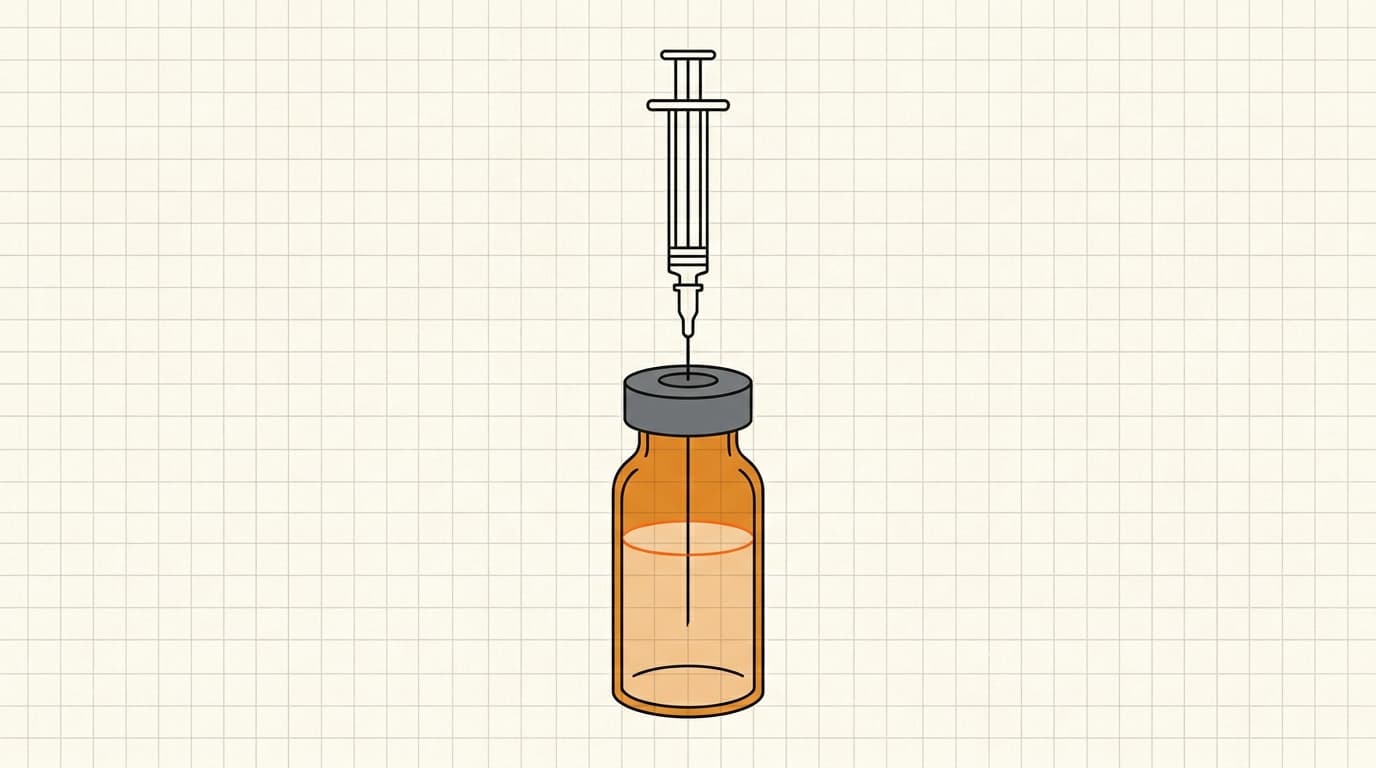
Concentration (mg/mL) = total peptide in the vial (mg) ÷ BAC water added (mL). A 5 mg vial with 2 mL of water added is 2.5 mg/mL. Get the units right (mg vs mcg, and which syringe you are reading) before you draw anything up; the formula itself is simple, the units are where the mistakes happen.
The reconstitution formula, and the two things that break it
Reconstitution means adding a liquid to a freeze-dried (lyophilized) peptide so it can be drawn into a syringe. The math behind it is one division:
Concentration = Total peptide in the vial (mg) ÷ BAC water added (mL)
Almost every mistake here is not the formula. It is one of two things: mixing up milligrams (mg) and micrograms (mcg), which are off by a factor of 1,000, or reading the wrong syringe scale once the concentration is known. Get the concentration right first, in one consistent unit, before touching a syringe.
A worked example
Take a 5 mg vial and add 2 mL of bacteriostatic (BAC) water:
5 mg ÷ 2 mL = 2.5 mg/mL, which is the same as 2,500 mcg/mL.
A standard insulin syringe is marked in units, where 100 units equals 1 mL (a “U-100” syringe). Each unit is therefore 1/100th of a mL, so at 2,500 mcg/mL, one unit carries 2,500 ÷ 100 = 25 mcg. That single conversion (mL to units, at your specific concentration) is what the rest of this math exists to support.
How concentration changes with the water you add
The same vial gives a different concentration depending on how much water goes in: more water means a lower concentration and a larger volume per dose; less water means a higher concentration and a smaller volume per dose. Neither is “correct” on its own; it is a tradeoff between dose precision and syringe volume. The same tradeoff shows up in nasal peptide sprays, just measured in spray counts instead of syringe units.
| Vial size | 1 mL BAC water | 2 mL BAC water | 3 mL BAC water | 5 mL BAC water |
|---|---|---|---|---|
| 2 mg | 2 mg/mL | 1 mg/mL | 0.67 mg/mL | 0.40 mg/mL |
| 5 mg | 5 mg/mL | 2.50 mg/mL | 1.67 mg/mL | 1 mg/mL |
| 10 mg | 10 mg/mL | 5 mg/mL | 3.33 mg/mL | 2 mg/mL |
| 15 mg | 15 mg/mL | 7.50 mg/mL | 5 mg/mL | 3 mg/mL |
Insulin syringes are not all the same scale: U-40 and U-100 syringes are marked differently, and reading a U-40 syringe as if it were U-100 (or the reverse) gives a volume that is off by more than double. Always confirm which syringe you are holding before converting a dose into units.
Why get this exact, rather than estimate
A rounding error in most kitchen math costs you a pinch of salt. Here, it is a different order of magnitude: mixing up mg and mcg alone is a 1,000x error, and a mislabeled vial or a water volume that was eyeballed rather than measured carries the error into every draw from that vial until it is empty. Measuring the water precisely and doing the division in one consistent unit is the entire safeguard. HGH vials add one more wrinkle: some are labeled in IU instead of mg, which needs converting before this formula applies.
You can run this exact math for free right here: the Dosing Calculator takes a vial size and the water you added and returns the concentration and the syringe units for a given dose, no app or account needed. It is the same engine built into the Stackeddd app, so the numbers match what you see when you log a dose. The arithmetic is not something you redo from memory every time.
Frequently asked questions
What is BAC water?
Bacteriostatic water — sterile water with a small amount of benzyl alcohol added as a preservative, which is what allows a reconstituted vial to be drawn from more than once. It is distinct from plain sterile water, which is typically single-use only once a vial is opened.
Does the formula change for different peptides?
No. Concentration is mass divided by volume — milligrams of peptide in the vial divided by milliliters of water added. That relationship holds regardless of which peptide is in the vial; only the vial size and the water you add change the answer.
What if I add more or less water than I planned?
Recalculate from what actually happened, not from the plan. Concentration is total mg in the vial divided by the actual mL you added — if you added 2.3 mL instead of 2 mL, use 2.3 in the formula. Guessing from the intended volume is how errors compound.
Can Stackeddd do this math for me?
Yes. The Calculators inside the Stackeddd app take a vial size and a water volume and return the concentration and the syringe units for a given dose automatically, so you are not doing the division by hand every time.
Is this medical or dosing advice?
No. This is arithmetic — how to read a concentration once a vial is mixed. It is not a recommendation for what to reconstitute, how much to draw, or what dose to take. Those are decisions for you and your prescribing physician.
Sources
- The concentration arithmetic is definitional: total peptide divided by the water you actually added. Every worked example here was re-checked against that relationship.
- The one external fact this math rests on is the syringe scale. U-100 means 100 units per millilitre, so one unit is 0.01 mL — that is what converts a concentration into units to draw, and it is a labeled standard rather than a convention. Humulin R U-100 prescribing information (FDA).
This is educational information, not medical advice. It explains how to read a concentration once a vial is mixed. It is not a recommendation for what to reconstitute or what dose to take. Talk to your prescribing physician about your protocol.

Written by
Jason Jeffries
Founder of Stackeddd. Data analytics by day (12 yrs), training for 20, juggling a full-time job, family, and app development. I run TRT and peptides myself, and I built Stackeddd because my whole tracking system was a notebook in a drawer in my bathroom. I’m not a doctor and none of this is medical advice.
STACKEDDD
Track it instead of guessing.
Doses, bloodwork, and an AI coach grounded in your own data — free to start, on the App Store and Google Play.