Nasal Peptide Sprays: The Actuation Math Nobody Explains
A nasal pump meters a fixed volume per spray, so the mcg you get depends on the concentration you loaded and the pump you loaded it into. Here are the two formulas, worked examples from powder to sprays, and a reference table across pump volumes.
By Jason Jeffries · July 3, 2026
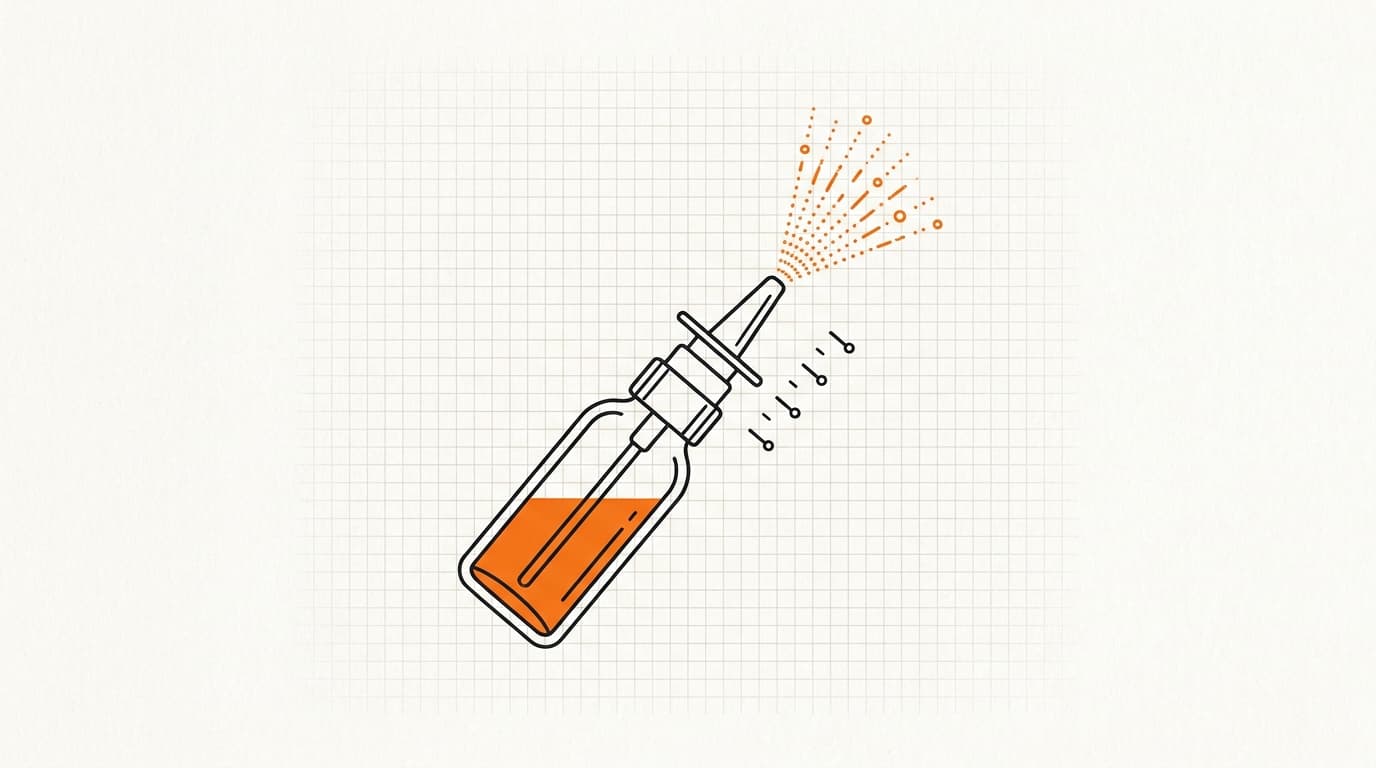
A metered nasal pump releases the same fixed volume every spray — commonly around 0.1 mL (100 microlitres), though pumps vary from roughly 0.05 to 0.14 mL, so confirm yours. Then mcg per spray = concentration (mcg/mL) × mL per spray, and sprays per dose = target mcg ÷ mcg-per-spray. A 2,000 mcg/mL solution in a 0.1 mL pump is 200 mcg per spray, so a 400 mcg target is 2 sprays. Your target is set by your prescriber; this is the arithmetic that turns it into sprays.
What one “spray” actually delivers
A metered nasal pump is a dosing device, not just a mister. Each press of the actuator draws up and expels the same fixed volume of liquid — the pump is engineered so that one full stroke meters one set amount, the same way a Topi-Click meters a fixed volume of cream per click. That is what lets you dose a nasal peptide by a countable number of sprays instead of guessing at a squirt.
The key detail is what a spray meters: volume, not micrograms. A very common metered pump delivers about 0.1 mL (100 microlitres) per spray, but that is a convention, not a law — real pumps range from roughly 0.05 mL to 0.14 mL per actuation depending on the model. That number is fixed by the hardware and has nothing to do with what is inside; it is the same whether the bottle holds a strong peptide solution or plain saline.
Because a spray meters a fixed volume, the micrograms in that spray depend entirely on the concentration you loaded. Two people with the exact same 0.1 mL pump get completely different doses per spray if their solutions are mixed at different strengths — one at 1,000 mcg/mL gets 100 mcg a spray, one at 2,000 mcg/mL gets 200 mcg a spray. There is no universal “mcg per spray” number to look up. It is always concentration × spray volume, computed for your bottle.
The math, in three lines
Everything in this post is these three relationships, applied to different numbers:
concentration (mcg/mL) = total peptide (mcg) ÷ total liquid (mL)
mcg per spray = concentration (mcg/mL) × mL per spray
sprays per dose = target dose (mcg) ÷ mcg per spray
The first sets your concentration when you mix the bottle. From there, the second turns the pump's fixed volume into a microgram amount. The third then turns a target dose into a countable number of sprays. Do them in that order and the arithmetic never gets more complicated than this. One unit note before you start: work in micrograms the whole way through — a milligram is 1,000 mcg, and mixing the two is the one error that is off by a factor of a thousand.
Worked example: from powder to sprays
Start with 10 mg of a peptide and reconstitute it with 5 mL of bacteriostatic water, loaded into a pump that meters 0.1 mL per spray. A target of 400 mcg:
- concentration = 10 mg ÷ 5 mL = 2 mg/mL = 2,000 mcg/mL
- mcg per spray = 2,000 mcg/mL × 0.1 mL = 200 mcg
- sprays = 400 mcg ÷ 200 mcg = 2 sprays
That is the entire pipeline: milligrams become a concentration, that concentration becomes a per-spray amount, and the per-spray amount becomes a spray count. Notice the milligram-to-microgram step in the first line — 10 mg is 10,000 mcg, so 10,000 ÷ 5 mL is 2,000 mcg/mL. Keep it in mcg from there and nothing else has to convert.
A PT-141 nasal setup, and why fill strength matters
Say you reconstitute 10 mg of a peptide in 10 mL of BAC water, in the same 0.1 mL pump, targeting a 1 mg (1,000 mcg) dose:
- concentration = 10 mg ÷ 10 mL = 1,000 mcg/mL
- mcg per spray = 1,000 mcg/mL × 0.1 mL = 100 mcg
- sprays = 1,000 mcg ÷ 100 mcg = 10 sprays
Ten sprays for a single dose is a lot — it is slow, it wastes solution to priming, and it is easy to lose count. That is why a more concentrated fill is usually chosen. Put the same 10 mg into 5 mL instead of 10 mL:
- concentration = 10 mg ÷ 5 mL = 2,000 mcg/mL
- mcg per spray = 2,000 mcg/mL × 0.1 mL = 200 mcg
- sprays = 1,000 mcg ÷ 200 mcg = 5 sprays
Halving the water doubles the concentration, doubles the mcg per spray, and halves the spray count — same peptide, same 1,000 mcg dose, five sprays instead of ten. The tradeoff is precision: a stronger fill means each spray is a bigger step, so a target that is not a clean multiple of the per-spray amount rounds less neatly.
The variable people forget: your pump's volume
Every chart above assumed a 0.1 mL pump. Change the pump and the answer changes, even with the exact same solution. Take a 2,000 mcg/mL fill and hold it constant:
- 0.05 mL pump: 2,000 × 0.05 = 100 mcg per spray
- 0.1 mL pump: 2,000 × 0.10 = 200 mcg per spray
- 0.14 mL pump: 2,000 × 0.14 = 280 mcg per spray
For a 400 mcg target that is 4 sprays, 2 sprays, or about 1.4 sprays depending on nothing but the pump. If you copied a spray count from someone with a 0.1 mL pump and used it on a 0.05 mL pump, you would take half the intended dose. Confirming your pump's metered volume is not a footnote — it is a direct multiplier on every dose you take.
Reference table: mcg per spray
mcg per spray for common concentrations, across three pump volumes. Read down your concentration, across to your pump's metered volume:
| Concentration | 0.05 mL per spray | 0.1 mL per spray | 0.14 mL per spray |
|---|---|---|---|
| 1000 mcg/mL | 50 mcg | 100 mcg | 140 mcg |
| 2000 mcg/mL | 100 mcg | 200 mcg | 280 mcg |
| 3000 mcg/mL | 150 mcg | 300 mcg | 420 mcg |
| 4000 mcg/mL | 200 mcg | 400 mcg | 560 mcg |
The single most-skipped number in nasal dosing is the pump's metered volume. Charts and forum posts default to 0.1 mL because it is common, but it is not universal — a pump that delivers 0.05 mL or 0.14 mL will make every one of those charts wrong for you. Check the volume printed on the pump or its packaging, and if you can, verify it: prime the pump, then count how many full sprays it takes to empty a known volume of water. Total volume ÷ number of sprays is your real per-spray volume. Use that number, not the assumption.
You can run this exact math for free right here — the Nasal tab of the Dosing Calculator does it for your concentration and pump volume. Enter them and it returns mcg-per-spray and sprays-per-dose, no app or account needed. It is the same engine built into the Stackeddd app, so the numbers match what you see when you log a dose.
For the mixing step underneath this — how much bacteriostatic water to add to hit a given concentration — see the peptide reconstitution math. And for plain-language background on the compounds people most often run as nasal sprays, the library has pages on PT-141, Selank, and Semax.
Frequently asked questions
How many mcg is one spray of a nasal peptide?
It depends entirely on the concentration you loaded into the bottle, because a nasal pump meters a fixed volume, not a fixed dose. A common metered pump releases about 0.1 mL (100 microlitres) per spray, but pumps vary from roughly 0.05 to 0.14 mL, so confirm the number for your pump. Multiply that volume by your concentration in mcg/mL to get the mcg. A 2,000 mcg/mL solution in a 0.1 mL pump is 2,000 × 0.1 = 200 mcg per spray.
How do you calculate a nasal peptide dose?
Two steps. First find mcg per spray: concentration (mcg/mL) × mL per spray. Then divide your target dose by that number: sprays = target mcg ÷ mcg-per-spray. If a solution is 200 mcg per spray and the target is 400 mcg, that is 400 ÷ 200 = 2 sprays. The target itself is set by your prescriber. This is only the arithmetic that turns it into a spray count.
How much liquid does one nasal pump spray?
A metered nasal pump is built to release the same fixed volume every actuation, and that volume is a property of the pump hardware, not the liquid inside. Many peptide nasal pumps deliver about 0.1 mL (100 microlitres) per spray, but the figure ranges roughly 0.05 to 0.14 mL across different pumps. The only reliable number is the one specified for your specific pump: do not assume 0.1 mL, confirm it, because it is a direct multiplier on every dose.
How do you reconstitute a peptide for nasal use?
Same first step as any reconstitution: dissolve the freeze-dried peptide in bacteriostatic water, then load the solution into a metered spray bottle. The concentration is total peptide divided by total liquid: 10 mg (10,000 mcg) dissolved in 5 mL is 10,000 ÷ 5 = 2,000 mcg/mL. Once you know the concentration and your pump volume, mcg per spray is concentration × pump volume.
Why would you choose a more concentrated nasal fill?
To keep the number of sprays per dose sensible. Because sprays = target mcg ÷ mcg-per-spray, and mcg-per-spray = concentration × pump volume, a more concentrated fill puts more mcg in each spray and so needs fewer sprays for the same dose. A dilute fill that needs eight or ten sprays per dose is awkward and wastes solution to priming; concentrating the same peptide into less water brings the spray count down. It is the same tradeoff as reconstitution generally: concentration versus volume per dose.
Can Stackeddd do this math for me?
Yes. The Nasal tab of the free Dosing Calculator takes your concentration and pump volume and returns mcg-per-spray and sprays-per-dose automatically. It is the same engine built into the Stackeddd app, so the numbers match what you see when you log a dose.
Sources
- Metered nasal pumps are manufactured in a small set of fixed actuation volumes, most commonly 50, 100 and 140 µL— which is the 0.05 to 0.14 mL range used throughout this post. That is why the pump is a direct multiplier on every dose, and why assuming 100 µL on a 140 µL pump overshoots by 40%. Nasal drug delivery devices: characteristics and performance in a clinical perspective (PMC).
- The same review notes that roughly 100 µL per nostril is about the practical ceiling in adults, with larger volumes tending to run back out rather than deposit — a physical limit on solving a dose problem by spraying more.
- The rest is definitional: mcg per spray = concentration (mcg/mL) × metered volume (mL). Every worked example was re-checked against that relationship.
This is educational information, not medical advice. Your target dose, concentration, and whether a compound is appropriate for you are set by your prescribing physician — this post only explains the arithmetic for turning a target into a number of sprays.

Written by
Jason Jeffries
Founder of Stackeddd. Data analytics by day (12 yrs), training for 20, juggling a full-time job, family, and app development. I run TRT and peptides myself, and I built Stackeddd because my whole tracking system was a notebook in a drawer in my bathroom. I’m not a doctor and none of this is medical advice.
STACKEDDD
Track it instead of guessing.
Doses, bloodwork, and an AI coach grounded in your own data — free to start, on the App Store and Google Play.