CJC-1295 With DAC vs Without DAC: Why the Injection Schedule Is Completely Different
“CJC-1295” is two different molecules sold under one name. Adding DAC stretches the half-life from ~30 minutes to ~6–8 days, and that single change flips the schedule from daily to weekly and the GH pattern from a natural pulse to a steady bleed.
By Jason Jeffries · July 3, 2026
Before I settled on real GH, I spent a stretch researching CJC-1295 alongside ipamorelin and tesamorelin, and the DAC versus no-DAC split was the first thing that tripped me up: same name on the label, two molecules that behave nothing alike.
DAC (Drug Affinity Complex) adds an albumin-binding group, so the peptide hangs around for a ~6–8 day half-life and is injected weekly, keeping GHRH signaling constantly elevated. No-DAC (sold as Modified GRF 1-29) has no anchor, clears in ~30 minutes, and is injected daily(usually at bedtime), which preserves the body’s natural pulsatile GH rhythm. Same GHRH-analog job, opposite pharmacokinetics, and that one difference decides the whole schedule. Both are typically paired with a GHRP such as ipamorelin.
One name, two molecules
CJC-1295 is a synthetic GHRH analog, a modified fragment of growth-hormone-releasing hormone, the brain signal that tells your pituitary to release growth hormone. Instead of injecting GH directly, it nudges your own gland to do it, which preserves the natural feedback loop rather than overriding it. So far, so simple. The confusion is that “CJC-1295” is sold as two versions that behave completely differently, and the label doesn’t always make it obvious which one you have.
The dividing line is a single modification. DAC (Drug Affinity Complex) is a group that grabs onto albumin (an abundant blood protein) and rides along with it, which dramatically slows clearance. No-DAC, commonly sold as Modified GRF 1-29, has no such anchor and washes out in minutes. Same basic job; opposite pharmacokinetics. Everything downstream (how often you inject, when, and what your GH output looks like) falls out of that one difference. For the full compound background, see the CJC-1295 reference, which covers both forms.
| Attribute | No-DAC (Mod GRF 1-29) | DAC |
|---|---|---|
| Albumin anchor | None | Yes (Drug Affinity Complex) |
| Approx. half-life | ~30 minutes | ~6–8 days |
| Dosing frequency | Daily (sometimes multiple daily) | Weekly (sometimes split twice weekly) |
| Typical timing | At bedtime, to ride the overnight GH pulse | Any consistent day; timing matters far less |
| Effect on GH rhythm | Pulsatile: a brief spike, then off between doses | Constant: steady, continuously elevated signal |
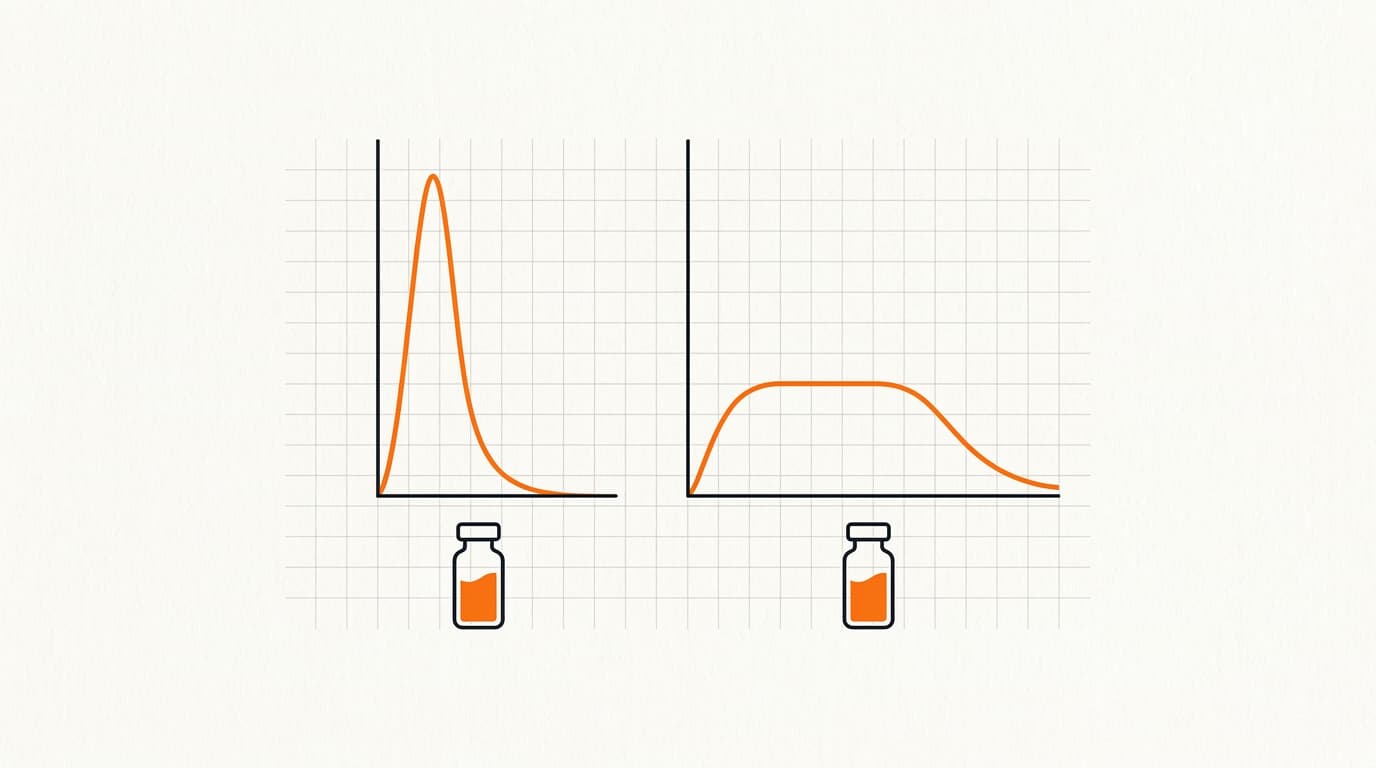
Half-life, drawn on one axis
The chart plots a single injection of each form, normalized so each starts at 100% of its own peak. It isolates one variable (how fast each one clears) over the same eight-day window. The no-DAC curve is a tall, fast spike that is essentially gone within the first hour; the DAC curve is a long, low plateau still comfortably present a week later. That is the entire difference, in one picture.
You can model a short vs long half-life peptide side by side in the free Blood-Level Simulator and watch how differently they accumulate: a daily short-acting dose sawtooths up and down, while a weekly long-acting one climbs to a steady plateau.
Why the schedule is completely different
No-DAC clears in about 30 minutes, deliberately. A short-lived GHRH pulse mimics the body’s own rhythm and lets somatostatin (the GH “off switch”) shut things back down between doses. That is why it is a daily, usually-bedtime peptide: you inject to ride your natural overnight GH pulse, then it’s gone. Miss a night and you miss that day’s pulse. The schedule punishes gaps, which is exactly the kind of daily streak worth logging.
DAC’s albumin binding stretches its half-life to roughly 6–8 days, so a weekly injection keeps GHRH signaling elevated the whole time. The convenience is real (one shot a week instead of seven), but it comes from constant presence. And constant GHRH can blunt the crisp natural pulse into more of a steady “bleed” of GH, which is the very rhythm no-DAC is designed to preserve. Neither one is better across the board; they are different tools with different trade-offs. What matters for tracking is knowing which one you have, because the calendar and the expectations are not interchangeable.
Reconstitution differs too — don’t assume
Because the two forms are dosed on such different scales, they are often reconstituted to very different concentrations even from the same vial size, and mixing that up is a common slip. A no-DAC vial diluted for small daily doses reads very differently on the syringe than a DAC vial set up for a single weekly draw. The arithmetic is the same in both cases; the numbers are not. If you want the mechanics, the peptide reconstitution math walks through exactly how much BAC water to add and how that maps to units on the syringe, and if you run CJC-1295 alongside its GHRP, the guide to mixing peptides in the same syringe covers which combinations can share a draw.
Why it’s almost always paired with a GHRP
A GHRH analog alone can be capped by somatostatin, so both forms of CJC-1295 are usually stacked with a GHRP, most commonly ipamorelin. The GHRP suppresses the “off switch,” and the two together produce a bigger, cleaner GH release than either on its own. This pairing holds whether you’re running the daily no-DAC form or the weekly DAC form: it addresses a different lever (the brake) than the CJC-1295 half-life question (the accelerator) does.
Why I skipped these
After all that research, I landed on real GH instead of the secretagogues. That’s my personal read, not a settled fact: my sense was that they work, but not as well as the real thing. I’ll be careful about the safety part, though. GH’s effect on blood sugar is dose-dependent; a lower dose carries a lower risk, but lower is not the same as safe, and clinical GH is titrated to IGF-1 blood levels under medical supervision. The fasting-glucose and IGF-1 monitoring involved is exactly why growth hormone belongs with a doctor and regular bloodwork, not something to freelance. That’s why I’m not personally running CJC-1295. If you are, or you’re weighing the DAC and no-DAC forms of it, everything above still applies.
Frequently asked questions
What is the difference between CJC-1295 with and without DAC?
DAC (Drug Affinity Complex) is a chemical modification that binds the peptide to albumin in the blood, stretching its half-life to roughly 6–8 days so it can be dosed weekly. No-DAC (commonly sold as Modified GRF 1-29) has no such anchor and clears in about 30 minutes, so it is dosed daily. Same GHRH-analog job, opposite pharmacokinetics, and that single difference dictates the entire injection schedule.
What is the half-life of CJC-1295 DAC vs no-DAC?
About 30 minutes without DAC, versus roughly 6–8 days with DAC. That ~300-fold gap is the whole reason one is a daily bedtime peptide and the other is a weekly injection: not a small dosing detail, but the defining property of each form.
How often do you inject CJC-1295 DAC?
Weekly, because the albumin binding keeps it present for roughly 6–8 days after a single injection; some people split it into two smaller injections across the week. This keeps GHRH signaling constantly elevated rather than pulsing. No-DAC is the opposite: a daily injection, usually at bedtime, because it is gone within about an hour.
Is Mod GRF 1-29 the same as CJC-1295 no-DAC?
Yes. Modified GRF 1-29 (also written Mod GRF 1-29) is the name the no-DAC version is usually sold under. When a vendor lists "CJC-1295 no-DAC" and "Mod GRF 1-29," they are referring to the same short-acting GHRH analog with a ~30-minute half-life. Only the DAC version carries the albumin-binding modification.
Do you need ipamorelin with CJC-1295?
It is the standard approach for either form. A GHRH signal on its own can be blunted by somatostatin (the body’s GH "off switch"), so CJC-1295 is usually paired with a GHRP such as ipamorelin, which suppresses that switch. Together they produce a larger, cleaner GH pulse than the GHRH analog alone.
Sources
These half-lives are not community estimates, which is unusual for this corner of the field.
- The DAC figure comes from a human trial. Teichman et al., Prolonged Stimulation of Growth Hormone and Insulin-Like Growth Factor I Secretion by CJC-1295, a Long-Acting Analog of GH-Releasing Hormone, in Healthy Adults, Journal of Clinical Endocrinology & Metabolism 91(3):799–805, 2006. Estimated half-life 5.8 to 8.1 days, with mean plasma IGF-I raised 1.5 to 3-fold for 9 to 11 days after a single injection. JCEM.
- Why no-DAC clears so fast, and why it is modified at all. Native GRF(1-29) is cleaved at the N-terminus by dipeptidyl peptidase-4, which recognises its Tyr-Ala motif and produces the inactive fragment GRF(3-29). Unmodified sermorelin survives only minutes as a result. Modified GRF 1-29 substitutes D-alanine at position 2, which blocks that cleavage and is what stretches it to roughly half an hour. PEGylation of GRF analogues, Advanced Drug Delivery Reviews.
- That is the whole design difference in one line: the no-DAC version fixes how fast the enzyme eats it, and DAC additionally anchors it to albumin so the kidney cannot clear it quickly. The first buys minutes, the second buys days.
This is educational information, not medical advice. CJC-1295 (both DAC and no-DAC / Modified GRF 1-29) is a research compound, not an approved medication. Any decision about using or dosing it belongs with a qualified medical professional.

Written by
Jason Jeffries
Founder of Stackeddd. Data analytics by day (12 yrs), training for 20, juggling a full-time job, family, and app development. I run TRT and peptides myself, and I built Stackeddd because my whole tracking system was a notebook in a drawer in my bathroom. I’m not a doctor and none of this is medical advice.
STACKEDDD
Track it instead of guessing.
Doses, bloodwork, and an AI coach grounded in your own data — free to start, on the App Store and Google Play.