My Estradiol Came Back at 75. The Anastrozole Is Still in the Drawer.
My prescriber gave me two options. I have one of them sitting in a drawer, unopened — because two tools is not the whole toolkit, and I wanted to know what the rest of it could do first.
By Jason Jeffries · July 27, 2026
I started testosterone on March 30th, 2026. 150mg a week, split between Monday and Thursday. A week before I started, my estradiol was 24 pg/mL— comfortably inside the 10–42 range my lab uses.
Two months in, I drew again. 75.
I want to be honest about my first reaction, because it was not analytical. It was: that’s not good. Am I going to get gynecomastia? Do I need to drop my test dose?
Four months later I have not dropped my dose, I have not taken an aromatase inhibitor, and I have a box of anastrozole sitting in a drawer that I have never opened. This is why.
The question my friend asked that I hadn’t thought to
The first thing I did was talk to my buddy Dustin. He did not tell me what to do. He asked me one question:
When did you take your last dose, compared to when the blood draw was taken?
Twenty-four hours. I had drawn my blood a day after an injection, which is about as close to peak as you can get.
Testosterone from an injection is not a flat line. It climbs after the shot and falls before the next one, and estradiol follows it, because the enzyme that makes estradiol works on whatever testosterone is actually there. So estradiol has a peak and a trough exactly like testosterone does. I had measured mine at the top of the hill and then panicked about the altitude.
So I drew again a month later, deliberately at trough — right before my next injection. Same 150mg, same Monday and Thursday, nothing else changed.
66. Nine points lower, from timing alone.
So when someone posts an E2 number in a thread, you will usually get the dose and the schedule. You will rarely get the draw time. Without it you are comparing numbers that were never comparable, including against your own previous result.
Two options, and the rest of the toolkit
66 is still over my lab’s range and I knew it. What I did not have was a single symptom. No tenderness, no swelling, nothing. Energy, libido, sleep and recovery had all improved since starting and stayed improved.
My prescriber knows all of this. They gave me two options: take an aromatase inhibitor, or lower the dose. Those are the two answers you will get almost everywhere, and they are both legitimate.
I have the anastrozole. And I sat and looked at it and thought: is that it? Are those really the only two moves I have?
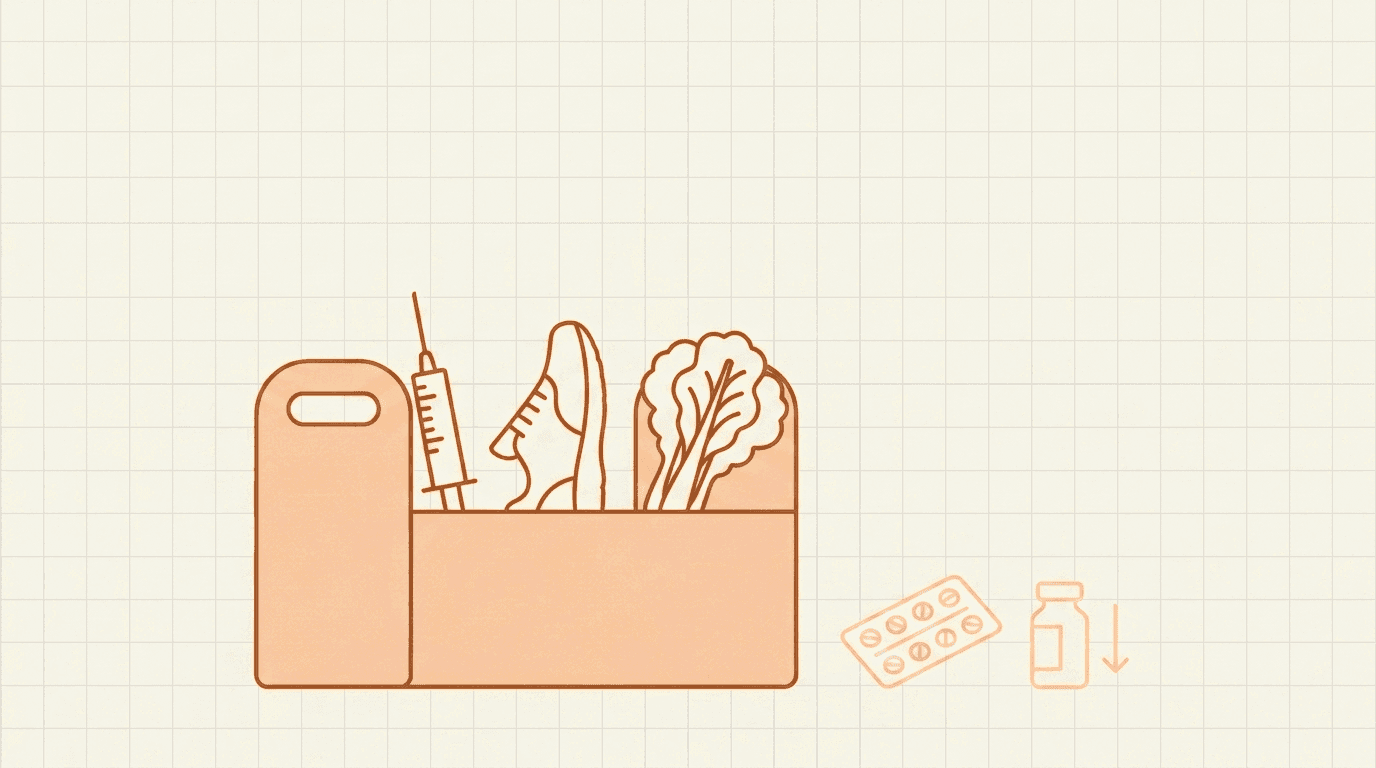
Because here is what I actually believe, and it is the whole reason for this post. We all aromatize differently, and for a lot of different reasons — how much body fat you carry, what your diet looks like, how much cardio you do, and, as I had just learned the hard way, what time you got your blood drawn. An AI and a lower dose are two tools in the toolkit. They are not the only two. And they were the two I would reach for last, not first.
So I decided to spend two months finding out what everything else could do, and to draw again at the end of August.
What I actually changed
I went from two injections a week to three. Same 150mg weekly total, just cut into smaller pieces. The reasoning is mechanical: aromatase converts the testosterone that is in front of it, so a smaller dose means a lower peak, and a lower peak should mean less conversion at the top of the curve.
I increased my cardio. Aromatase lives largely in fat tissue, so carrying less of it means less conversion capacity. That one is straightforward.
I increased my fiber. This is the one I would not have guessed, and I did not — I asked the AI coach inside my own app what levers existed besides the obvious two, and fiber came back. Estrogen that your liver sends out in bile can be freed up again by gut bacteria and reabsorbed before it ever leaves you. Fiber binds it and moves things along, so more of it actually goes out.
Where the evidence is, and where it runs out
I am not going to pretend the things I chose are better evidenced than the things I skipped. They are not. Here is the honest state of each.
Injecting more often. The mechanism is not controversial. A trial showing it meaningfully lowers estradiol in men is something I could not find. The claim is everywhere, often with a precise percentage attached, and I could not trace those percentages to a study.
Fiber. The mechanism is real and documented. A high-fiber diet has been shown to reduce serum estradiol — in women. Every study I found was in premenopausal or postmenopausal women. Nothing in men, and certainly nothing in men on testosterone, where estradiol is being produced continuously from a large external supply. The mechanism should still apply. Whether it applies enough to matter in my situation, nobody has tested.
Cardio and body fat. The firmest of the three, and the least exciting.
So I am running three changes with sound mechanisms and thin evidence, instead of one change with better evidence. I know that. I would rather find out what the low-risk levers do before I use the ones that are harder to undo.
Why I am scared of the anastrozole
I should say plainly what is behind that choice, because it is not sophistication. It is that I do not want to end up with low estradiol, and I think low is a worse place to be than high.
That belief has support, though not the comparison I just made. What the research shows is that estradiol is doing real work in men, not sitting there as a byproduct. The cleanest study on this took 400 men, shut down their own hormone production, replaced testosterone at five different doses, and blocked conversion to estradiol in half of them. Lean mass and strength tracked the testosterone. But fat accumulation tracked the estradiol— the men whose conversion was blocked gained more fat, not less. And libido and erectile function needed both. Not one or the other.
The bone data is even less arguable. A follow-up analysis found estradiol above roughly 10 pg/mL was generally enough to protect bone — and that when aromatization was suppressed, bone loss got worse independent of the testosterone dose. You cannot out-testosterone a suppressed estradiol where your skeleton is concerned.
So the downside of overshooting is well documented. Whether low is worse than high is my judgement call, not something I can show you a study for. I want to be clear about which is which.
The number I could not find
Somewhere in this I tried to answer a simple question: what is a good estradiol number for a man on testosterone? I could not find a validated one, and I looked properly.
The only figure I could locate in a major guideline is the American Urological Association’s: above 40 pg/mL, refer to an endocrinologist. But read the condition — that applies to men who present with breast symptoms. It is a referral trigger for symptomatic men, not a target for everyone. And the Endocrine Society’s testosterone guideline does not appear to set a routine estradiol target at all.
Which means the professional bodies treat estradiol as symptom-triggered, not number-triggered. That is not the impression you get from the internet, where a specific range gets quoted at you with total confidence. Every time I chased one of those ranges it landed on a clinic page or a supplement site, never on a study that tested outcomes at different estradiol levels.
There are also two different estradiol tests. The standard immunoassay is only considered appropriate above about 50 pg/mL and tends to overestimate below that — which is the entire range most men live in. One analysis found biases of 34% and 40% at concentrations in the mid-twenties. Get the ultrasensitive or LC-MS version, and never compare a result from one method against the other.
What happens at the end of August
I draw again at trough, on the same ultrasensitive assay, because that is the only way this means anything.
I would be happy in the high forties or low fifties. I want to be honest that this is not a validated target — it is where I personally would stop worrying, given I have no symptoms. It is a statement about me, not about the evidence.
And if it has not moved, I have said what I will do. I will pick one of the two tools I have been avoiding, and I am leaning toward lowering my dose from 150mg to 120mg a week rather than taking the anastrozole — for exactly the reason above. I would rather have slightly less testosterone than risk having far too little estradiol.
I am writing that down now, before I know the answer, so I cannot quietly move the goalposts when the result comes back. If the lifestyle changes do nothing, I will say so in a follow-up post, and that will be a useful result too.
We all aromatize differently, and for a lot of different reasons — body fat, diet, cardio, and what time you got your blood drawn. An aromatase inhibitor and a lower dose are two tools in the toolkit. They are not the only two, and they are not the first two I wanted to reach for. I am spending two months on the rest of the toolkit and then measuring it properly.
If you take one practical thing from this: write down when you drew. My whole scare came from a number that was nine points higher than it needed to be because I measured at the wrong moment. I built Stackeddd partly for this reason — every lab result sits next to the protocol and the injection log that produced it, so a number always carries its own context. You can also read more about estradiol in the compound library, which is free and needs no account.
Related: is more testosterone actually better? and how to track TRT bloodwork.
Frequently asked questions
What is a good estradiol level for a man on TRT?
I went looking for a validated number and could not find one. The only figure in a major guideline I could locate is the American Urological Association’s: above 40 pg/mL, refer to an endocrinologist — and that applies to men who present with breast symptoms. It is a referral trigger for symptomatic men, not a target for everyone. The Endocrine Society’s testosterone guideline does not appear to set a routine estradiol target at all. So the professional bodies treat estradiol as symptom-triggered rather than number-triggered, which is not the impression you get from the internet.
Should I test estradiol at peak or trough?
Pick one and never move. My own numbers are the argument: 75 drawn 24 hours after an injection, then 66 a month later drawn at trough, on the identical dose and schedule. Nine points apart from timing alone. Trough is the more common convention because it is easier to reproduce — it is just before your next shot — but consistency matters more than which you choose. A number with no draw time attached cannot be compared to anything, including your own previous result.
Why is my estradiol high on TRT?
Testosterone converts to estradiol through aromatase, an enzyme that lives largely in fat tissue. More testosterone in circulation means more raw material for that conversion, so estradiol rising on TRT is expected rather than a malfunction. How much it rises varies a lot between people — body fat is a major driver, and so is how much testosterone is in your blood at the moment you drew.
Does injecting testosterone more often lower estradiol?
The mechanism is sound: aromatase works on the testosterone actually available to it, so a smaller and more frequent dose means a lower peak and less conversion at that peak. What I could not find is a trial demonstrating it in men. The claim is made confidently across clinic sites and forums, often with a specific percentage attached, and I could not trace those figures to a study. That is exactly why I am measuring it on myself instead of quoting someone else’s number.
Can diet or cardio lower estradiol?
Cardio has the clearer rationale — aromatase lives largely in fat tissue, so less body fat means less conversion capacity. Fiber is more interesting and less settled. Estrogen sent out in bile can be freed by gut bacteria and reabsorbed, and fiber binds it and speeds transit so more leaves in stool. Studies have shown a high-fiber diet reducing serum estradiol — but those studies were in women. I could not find anything testing it in men, let alone men on testosterone. The mechanism is real; whether it moves the needle in my situation is untested, which is part of what I am finding out.
Is low estradiol worse than high estradiol?
That is what I believe, and it is why I have not taken the aromatase inhibitor sitting in my drawer — but I want to be careful, because "worse than" is a comparison I cannot show you evidence for. What the evidence does show is that low estradiol causes real problems in men. In a controlled study, men whose conversion to estradiol was blocked gained more fat, not less, and both androgens and estrogens were needed for normal libido and erectile function. A separate analysis found that suppressing aromatization made bone loss worse independent of the testosterone dose. So the downside of going too low is well documented. Whether it is worse than being high is my judgement, not a finding.
Sources
- The numbers here are my own lab results, from my own draws, on my own protocol. That makes them real and it makes them a sample of one. Nothing about my estradiol reading generalises to anyone else's.
- Which assay produced the number matters as much as the number. The standard immunoassay and the sensitive LC/MS assay read differently at male-range levels, so results from the two cannot be compared to each other or plotted as one trend. If you take one thing from this page into your own tracking, take that. More on setting up the panel .
- What I deliberately do not claim: that an aromatase inhibitor is the wrong choice, or that the approach I am trying first is better. I have one data point and a follow-up draw scheduled. Anyone presenting a confident general answer about managing estradiol on testosterone, in either direction, is ahead of the evidence.
This is my own experience and general education, not medical advice. It is not a recommendation to start, change, or stop testosterone, to change an injection schedule, or to take or avoid any medication. My prescriber is aware of my bloodwork and of what I am doing. Everyone’s physiology, labs, and risks are different — talk to a qualified medical provider about your own.

Written by
Jason Jeffries
Founder of Stackeddd. Data analytics by day (12 yrs), training for 20, juggling a full-time job, family, and app development. I run TRT and peptides myself, and I built Stackeddd because my whole tracking system was a notebook in a drawer in my bathroom. I’m not a doctor and none of this is medical advice.
STACKEDDD
Track it instead of guessing.
Doses, bloodwork, and an AI coach grounded in your own data — free to start, on the App Store and Google Play.