Testosterone Esters Compared: Propionate vs Cypionate vs Enanthate vs Undecanoate (Half-Life & Injection Frequency)
The ester is an oil-soluble chain bolted onto the testosterone molecule. It changes how fast the hormone is released. Nothing else. Once it is cleaved off, your body sees identical testosterone. Here is what differs between propionate, enanthate, cypionate, and undecanoate.
By Jason Jeffries · July 3, 2026
I run testosterone cypionate. Honestly, for the simplest reason: it’s the most popular one, and when I dug through other people’s anecdotal reports, it looked like the best fit for me. I didn’t pick it off a chart of half-lives. The one below is the closest I’ve come to seeing one laid out.
All of these are the same hormone. The ester (propionate, enanthate, cypionate, undecanoate) is a chain attached to the testosterone that only controls how quickly it is released once injected. Once enzymes cleave the ester off, the free testosterone is identical. So “which ester is stronger” is largely a myth. What differs is half-life (which sets injection frequency), peak-to-trough swing, and the share of each milligram that is actual testosterone (a heavier ester means less hormone per mg).
What an ester actually is — and why it doesn’t change the hormone
A testosterone ester is a fatty-acid chain chemically bonded to the testosterone molecule. That chain does one job: it makes the molecule oil-soluble so it lingers in the injection depot and releases slowly instead of hitting your bloodstream all at once. The longer and more oil-loving the chain, the slower the release. That is the entire difference between propionate, enanthate, cypionate, and undecanoate.
Here is the part that undoes most of the “which ester is best” folklore: the ester is never active. Your body’s enzymes cleave it off, and what is left, the free testosterone, is exactly the same molecule regardless of which ester delivered it. There is no such thing as “cypionate testosterone” being different from “enanthate testosterone” at the receptor. The receptor never sees the ester. So the real comparison isn’t about strength at all: it’s about timing and math.
The comparison table
Two things vary across esters, and both come straight from the length of that chain. First, half-life (how long it takes the level to fall by half), which sets how often you have to inject and how much the level swings between shots. Second, percent testosterone by weight: because the ester is dead weight that gets cleaved off, a heavier ester means fewer of the labeled milligrams are actual hormone.
| Form | Approx. half-life | Typical injection frequency | ~% testosterone by weight | Peak / trough character |
|---|---|---|---|---|
| Propionate | ~0.8–2 days | Every 1–2 days | ~84% | Sharp peak, quick drop; biggest swing of the injectables |
| Enanthate | ~4.5 days | Every 3.5–7 days | ~72% | Moderate swing; flattens with more frequent dosing |
| Cypionate | ~7–8 days | Every 3.5–7 days | ~70% | Moderate swing; practically indistinguishable from enanthate |
| Undecanoate (injectable) | ~20–34 days | Every ~10–14 weeks | ~63% | Very flat, broad plateau; small swing over a long interval |
| Suspension (no ester) | ~hours | Multiple times per day | 100% | Enormous spike, gone within a day; not used for maintenance |
A note on blends: Sustanon is not a single ester: it is a fixed blend of four testosterone esters (propionate, phenylpropionate, isocaproate, and decanoate) mixed in one oil. The idea is a fast onset from the short esters plus a longer tail from the long ones, so the curve is a stack of the individual half-lives rather than one clean number. In practice the short components fade quickly, so a steady level still depends on injecting often enough to cover them. A blend does not remove the frequency question; it blurs it. Details on the individual compounds live in the Sustanon library entry.
The half-life difference, drawn out
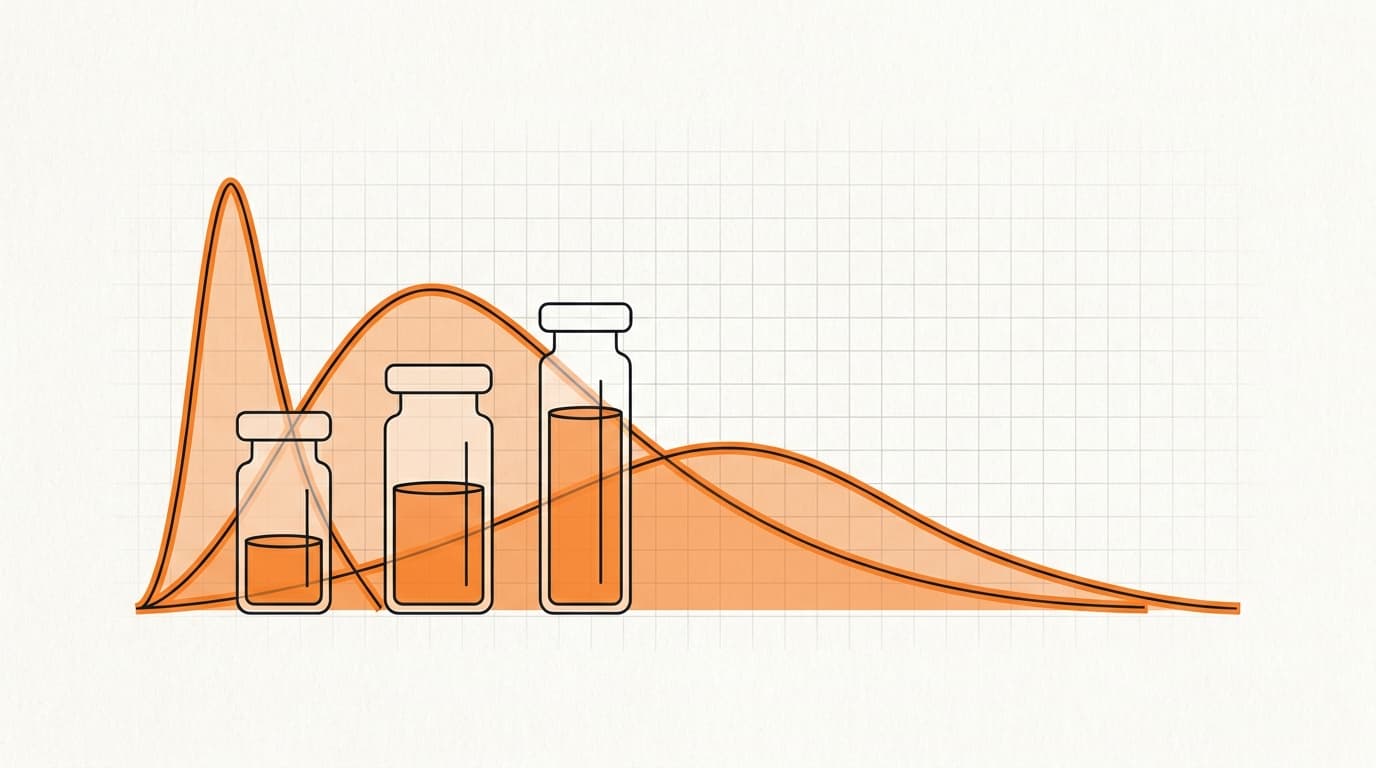
The chart below plots a single dose of each ester decaying on its own, every curve starting at the same point the moment of the shot. It isolates one variable (how fast each one clears), so the short-versus-long-ester gap is visible instead of abstract. Watch how propionate falls off a cliff while undecanoate has barely moved four weeks later.
A short ester needs a new dose before that steep drop bottoms out, which is exactly why propionate is injected every day or two and undecanoate can go months. It is not that one is “more powerful”: it is that the short one leaves the building faster, so you refill more often to keep the level from cratering.
The chart above is the decay of a single dose. It is not the same as the steady-state line you live on, which is many overlapping doses summed together. A short ester on a frequent schedule can end up with a flatter steady-state line than a long ester on a lazy one. If you want to see the difference between holding the ester constant and varying the schedule, that is the companion read below.
Why heavier esters carry less testosterone per milligram
Because the ester is cleaved off and discarded, only part of each labeled milligram is the hormone that reaches your receptors; the rest is the chain. The heavier the chain, the smaller that share. Propionate is a short, light ester, so about 84% of its weight is testosterone. Undecanoate is a long, heavy ester, so only about 63% is. Cypionate and enanthate sit close together in the low 70s.
This is the quiet reason the same labeled milligrams of two esters do not deliver the same amount of hormone, and why comparing esters purely by their milligram number is misleading. The number on the vial is ester-plus-testosterone; the number your body responds to is only the testosterone fraction of it.
So what actually differs between esters?
Boiled all the way down, only three things, and none of them is potency:
- Half-life → injection frequency. Short ester, inject often; long ester, inject rarely.
- Peak-to-trough swing. A short half-life on a given interval swings harder between doses; a long one rides flatter.
- Testosterone per milligram. A heavier ester means a smaller hormone fraction of each labeled milligram.
Everything else people attribute to “the ester” (how it makes them feel, how much testosterone they end up with) comes from the dose, the schedule, and their own metabolism, not from some special property of the chain. Once it is cleaved, it is all the same hormone.
See it on a specific compound and dose
The decay chart above uses one dose per ester to isolate half-life. If you want to model a real protocol, pick an ester, set a dose and an injection frequency, and watch the peak, the trough, and the steady-state level build over weeks. The free Blood-Level Simulator runs exactly that curve for any ester. It is the fastest way to see, for your own case, how much the frequency flattens the line. Stackeddd then logs your real injections against the same engine, so the chart tracks what you did instead of a plan.
Read more
- Compound library: Testosterone Propionate · Testosterone Enanthate · Testosterone Cypionate · Testosterone Undecanoate
- TRT injection frequency: holds the ester constant and varies the schedule; the other half of this story.
- The TRT math: turning labeled milligrams into the actual hormone your body sees.
Why I run cypionate
If a chart like the one on this page doesn’t settle it for you, that’s normal. I didn’t choose off one either, and plenty of people don’t. Whichever ester you land on, Stackeddd logs each shot against it, the same engine behind the chart above.
Frequently asked questions
Which testosterone ester has the longest half-life?
Injectable testosterone undecanoate, by a wide margin (roughly 20 to 34 days, depending on the source). That is why it can be dosed as infrequently as once every ten to fourteen weeks after a loading phase, versus every few days for the shortest ester. Cypionate (~7–8 days) and enanthate (~4.5 days) are in the middle; propionate (~0.8–2 days) is the shortest of the common injectables.
Is testosterone cypionate stronger than enanthate?
No. They are effectively interchangeable in potency. The ester only changes how fast the testosterone is released: once your enzymes cleave it off, the free testosterone is identical molecule-for-molecule. Cypionate has a slightly longer half-life (~7–8 days vs ~4.5) and is a hair heavier, so a milligram of cypionate carries a touch less testosterone than a milligram of enanthate, but neither is "stronger" in any meaningful sense.
Which testosterone ester needs the most frequent injections?
Because it has the shortest half-life among the common injectable esters, propionate is typically injected every one to two days to avoid a deep trough. Plain testosterone suspension (no ester at all) clears in hours and would need multiple injections a day, which is why it is almost never used for maintenance. The longer the ester, the less often it has to be injected.
What is the difference between testosterone cypionate and undecanoate?
Almost entirely release timing. Cypionate has a half-life of roughly 7–8 days and is usually injected every few days to once a week; injectable undecanoate has a half-life of roughly 20–34 days and can be injected once every ten to fourteen weeks. Undecanoate is also a heavier ester, so a milligram of it is a smaller fraction of actual testosterone (~63%) than a milligram of cypionate (~70%). The steady-state testosterone your body sees is the same molecule either way. The two differ in how flat the curve is and how often you inject.
What does “short ester vs long ester” actually mean?
It refers to the length of the fatty-acid chain bonded to the testosterone. A short chain (like propionate) dissolves out of the injection depot and gets cleaved quickly, giving a short half-life and a sharp peak-and-trough. A long chain (like undecanoate) releases slowly over weeks, giving a long half-life and a flat, broad curve. Short vs long is about the timing of the release, not the strength of the hormone.
Does a heavier ester mean less testosterone per milligram?
Yes. The ester is dead weight in the sense that it gets cleaved off and does nothing hormonal, so the heavier the ester chain, the smaller the share of each milligram that is actual testosterone. Propionate is about 84% testosterone by weight, enanthate ~72%, cypionate ~70%, and undecanoate ~63%. Testosterone suspension is 100% because it has no ester. This is why the same labeled milligrams of different esters do not deliver the same amount of hormone.
Sources, and which half-life these are
Worth being precise about, because “half-life” means more than one thing here. The figures on this page are terminal elimination half-lives, the number product labeling quotes and the one people mean in conversation. A pharmacokinetic simulator modelling the shape of a curve uses different parameters, describing how the oil depot releases the ester rather than how fast the body clears it once released. Both are correct and they are not the same number, so a curve fitted with depot-release constants will not simply be a decay at the half-life quoted below.
- Depo-Testosterone (testosterone cypionate) prescribing information — the approximately 8-day figure. Pfizer, clinical pharmacology.
- Aveed (testosterone undecanoate) prescribing information — the long-acting end of the range, dosed once every ten weeks after the initial loading interval. FDA.
- The decay chart is a single-dose exponential using the labeled half-life for each ester, drawn to isolate the effect of chain length. It is deliberately not a steady-state model; for that comparison see injection frequency .
This is educational information about pharmacology, not medical advice or a dosing recommendation. Testosterone is a prescription medication: which ester, dose, and schedule are appropriate is a decision for you and your prescribing physician.

Written by
Jason Jeffries
Founder of Stackeddd. Data analytics by day (12 yrs), training for 20, juggling a full-time job, family, and app development. I run TRT and peptides myself, and I built Stackeddd because my whole tracking system was a notebook in a drawer in my bathroom. I’m not a doctor and none of this is medical advice.
STACKEDDD
Track it instead of guessing.
Doses, bloodwork, and an AI coach grounded in your own data — free to start, on the App Store and Google Play.