Bacteriostatic Water: What the 0.9% Actually Is, and How Much of It You Inject
I have been injecting a preservative almost daily for two years without ever checking what it was or how much of it I was getting. The regulators had already published every number I needed, and the answer is smaller than I expected and less simple than I hoped.
By Jason Jeffries · August 8, 2026
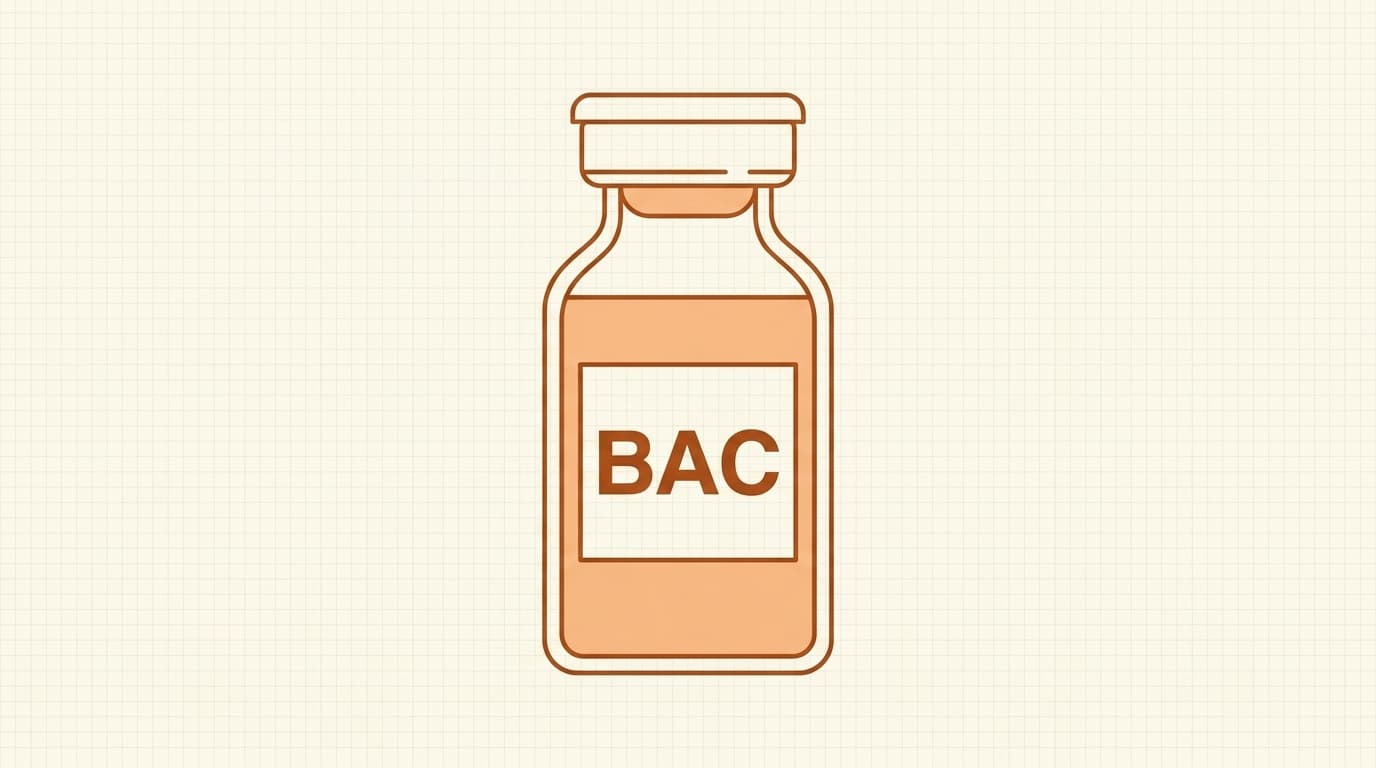
There is a vial in my refrigerator that I use more than any other single thing in this hobby, and until recently I could not have told you what was in it beyond “water.” Every peptide I reconstitute goes through it. Every injection I take carries a little of it. And printed across the front of its label is the sentence NOT FOR USE IN NEONATES, which is an arresting thing to read off a product you are about to inject and have never once researched.
So I researched it, and what I found split cleanly in two. The message boards either wave the preservative off entirely or treat it as a slow poison, and neither camp had a number. Meanwhile the regulators, it turns out, have published everything: the exact concentration, an acceptable daily intake, the toxic dose that earned that label warning, and the pH specification that explains half the vial-to-vial weirdness people blame on brands. This post is me lining those numbers up against a syringe.
Bacteriostatic water is sterile water with 0.9% benzyl alcohol (9 mg/mL) added so a vial can survive repeated needle punctures. A typical peptide injection of 0.1 to 0.5 mL delivers about 1 to 5 mg of benzyl alcohol, which for an 80 kg adult is roughly 0.3 to 1.4% of EFSA’s acceptable daily intake. The genuine cautions are categorical, not volumetric: it must never be used for newborns, and pregnancy, small children, and liver or kidney disease all carry their own warnings.
What bacteriostatic water actually is
Bacteriostatic Water for Injection, USP is sterile water containing 0.9% benzyl alcohol, which is 9 mg per mL, added as a bacteriostatic preservative, supplied in a multiple-dose vial from which repeated withdrawals can be made. Some presentations run 1.1% instead. That is the whole product. No salt, no buffer, no peptide-friendly additives. Water and preservative.
“Bacteriostatic” is doing precise work in that name: the benzyl alcohol suppresses the growth of bacteria that get introduced when a needle passes through the stopper. Every draw you take from a vial is an opportunity for contamination, and the preservative is what makes draw number fifteen reasonable instead of reckless. Its cousin, plain Sterile Water for Injection, contains, in the label’s words, no bacteriostat, antimicrobial agent or added buffer, and is supplied only in single-dose containers. Its instruction is blunt: do not reuse, discard the unused portion.
The same split exists for saline. Bacteriostatic 0.9% Sodium Chloride is the identical idea with salt in it, 9 mg/mL sodium chloride and the same 0.9% benzyl alcohol, in the same multiple-dose vial. The preservative, not the water, is what earns a container the multi-dose designation; USP’s 28-day window for an opened multi-dose vial applies specifically because an antimicrobial preservative is present. I wrote a whole post on how long bac water lasts after opening and what that 28-day figure does and does not say about the peptide dissolved in the water, so I will not repeat it here.
What the benzyl alcohol does, and what it does not
Benzyl alcohol is an aromatic alcohol used as a preservative in injectable drugs, topical products, and cosmetics, and it moonlights: the EMA notes it is used in intramuscular products partly because its mild anaesthetic properties reduce pain at the injection site. In your body it is metabolised to benzoic acid, the same compound used as a food preservative, and cleared. That metabolic route matters later in this post, because it is the reason regulators treat swallowed and injected benzyl alcohol as roughly interchangeable for setting limits.
Here is what it does not do, and this is the misconception I held myself: it does nothing for the peptide. Benzyl alcohol suppresses bacteria. It has no effect on hydrolysis, oxidation, or deamidation, which are the chemical routes that actually degrade a peptide in solution. Bacteriostatic water protects the solution from what might grow in it, not the molecule from falling apart. A peptide dissolved in bacteriostatic water degrades on exactly the same chemical clock it would in plain sterile water; the preservative just means the vial is not also a culture flask while it happens.
The math: how much benzyl alcohol are you actually injecting?
This is the section I could not find anywhere else, which is strange, because it is one multiplication and one division. The concentration is fixed at 9 mg/mL, so the only variable is how much volume you inject.
Say you reconstitute a vial and your daily dose works out to 0.25 mL, which is 25 units on a U-100 insulin syringe and a pretty typical peptide draw. You are injecting 0.25 mL × 9 mg/mL = 2.25 mg of benzyl alcohol. To judge whether 2.25 mg is a lot, you need a threshold, and there is a real one: in 2019 EFSA re-evaluated benzyl alcohol as food additive E 1519 and set an acceptable daily intake of 4 mg per kg of body weight per day, derived from a no-observed-adverse-effect level of 400 mg/kg/day in a rat carcinogenicity study, where 400 was simply the highest dose tested. An ADI is the amount you could take in every day for a lifetime without appreciable risk. For an 80 kg adult that is 80 × 4 = 320 mg per day.
| Daily injection volume | Benzyl alcohol | Share of the ADI (80 kg adult) |
|---|---|---|
| 0.10 mL · 10 units | 0.9 mg | 0.3% |
| 0.25 mL · 25 units | 2.25 mg | 0.7% |
| 0.50 mL · 50 units | 4.5 mg | 1.4% |
| 1.00 mL · 100 units | 9 mg | 2.8% |
Even a full milliliter a day, which is more bacteriostatic water than most protocols ever have you injecting, sits below three percent of the intake EFSA considers acceptable every day for life. A lighter person moves the needle less than you would think: at 60 kg the allowance drops to 240 mg and the full-milliliter case rises to 3.8%. To actually reach the ADI, an 80 kg adult would need to inject 320 ÷ 9 ≈ 36 mL of bacteriostatic water every single day. That is more than an entire 30 mL vial, every day.
Two cross-checks, because one threshold is an anecdote. The older WHO/JECFA evaluation puts benzyl alcohol in a group ADI of 0 to 5 mg/kg together with benzoic acid and the benzoates, expressed as benzoic acid equivalents; converting (benzyl alcohol’s molecular weight is 108, benzoic acid’s is 122, so multiply by about 1.13) turns the 0.5 mL dose into 5.1 mg of equivalents against a 400 mg allowance, which is 1.3%, the same answer. And the label of Bacteriostatic Sodium Chloride, the preserved saline, states that an estimated intravenous dose of up to 30 mL, which is 270 mg of benzyl alcohol, may be safely given to an adult without toxic effects. A 50-unit draw is one sixtieth of that volume.
I want to be precise about what I just did, because there is a trap in it. The ADI is an oral food-additive number, and we are talking about injections. The bridge is supplied by the EMA’s excipient review, not by me: oral absorption of benzyl alcohol is close to 100%, so, in their words, recommendations for oral use are considered applicable for other routes of administration. Swallowed or injected, essentially all of it ends up in circulation and takes the same metabolic exit. That is also why I am comfortable comparing a daily injection habit against a chronic daily-intake limit rather than a single-dose one; matching a chronic exposure to a chronic threshold is the honest pairing.
Where the scary label comes from
If the numbers are that small, why does every vial shout about neonates? Because in 1982 benzyl alcohol killed premature babies, and the warning is the scar tissue.
Neonatal ICUs at the time used benzyl-alcohol-preserved water and saline as routine flushes for umbilical catheters, many times a day, in patients who sometimes weighed barely a kilogram. Gershanik and colleagues described the result in the New England Journal of Medicine as the “gasping syndrome”: gasping respirations, metabolic acidosis, neurological deterioration, cardiovascular collapse, and death. Premature infants lack the metabolic capacity to clear benzyl alcohol, so it accumulated. The EMA puts the doses involved at around 100 to 200 mg per kg per day intravenously; FDA labeling pins the association at dosages above 99 mg/kg/day in neonates and low-birth-weight neonates.
Run those numbers against an adult for scale. For an 80 kg person, 100 mg/kg/day is 8,000 mg of benzyl alcohol, which at 9 mg/mL means injecting nearly 900 mL of bacteriostatic water a day. The neonatal tragedy required a patient a hundredth that size, an immature liver, and a fluid regimen delivering preservative around the clock. None of that describes an adult drawing 25 units into an insulin syringe. But it is exactly why the contraindication in newborns is absolute, why the label directs that only preservative-free water be used to prepare medications for neonates, and why that sentence is on the front of the vial rather than buried in the insert.
The honest caution list
I do not want this post to read as “the preservative is nothing, carry on,” because the sources themselves do not read that way. The real cautions, from the labels and the EMA review:
Neonates: never. Contraindicated outright, as above. This includes using bacteriostatic water to dilute anything destined for a newborn, which is a clinical scenario and not a peptide one, but the rule has no exceptions.
Pregnancy. The label says bacteriostatic water should be given to a pregnant woman only if clearly needed, and the EMA’s recommended leaflet language advises pregnant and breastfeeding women to ask a doctor first, because benzyl alcohol can build up and cause metabolic acidosis. No safe fetal exposure has been established; the regulators decline to invent one, and so will I.
Small children. The EMA advises against use for more than a week in children under 3 without medical advice, again on accumulation grounds. Not a scenario peptide users should be anywhere near, and I mention it only for completeness.
Liver and kidney disease. The clearance pathway runs through the liver and out the kidneys, and the EMA flags high volumes in hepatic or renal impairment as an accumulation risk. If your organs clear things slowly, your margin is smaller than the table above assumes.
And one line of honest uncertainty. FDA labeling for benzyl-alcohol-preserved products carries this sentence: the minimum amount of benzyl alcohol at which toxicity may occur is not known. The thresholds I used are the best published numbers, not a guarantee, and the gap between “well inside every published limit” and “proven harmless” is a gap regulators are careful about. I would rather show you the sentence than pretend it is not on the label.
The pH is a range, not a number
The other number on the label surprised me more than the preservative did. The pH of Bacteriostatic Water for Injection is listed as 5.7, with a permitted range of 4.5 to 7.0. Mildly acidic by default, and that range is enormous: pH is logarithmic, so 4.5 to 7.0 spans roughly a 300-fold difference in hydrogen-ion concentration, and a vial at either end is fully compliant, on-spec water.
The label promises the range, and only the range. This is unbuffered water: there is nothing in the formulation to hold a pH steady, so where inside 4.5 to 7.0 a given lot sits is not something any manufacturer commits to. The practical consequence: two vials of bacteriostatic water, same brand or different brands, can legitimately be hundreds of times apart in acidity, and for a peptide whose solubility or stability is pH-sensitive, that alone can make two reconstitutions behave differently with nobody doing anything wrong. Peptide degradation chemistry is strongly pH-dependent, which is a large part of why “keep it cold” was never the whole story in the post on how long reconstituted peptides last.
This is also the cleanest debunk of the brand folklore. When a fussy peptide clouds or gels, the threads reliably converge on buying a better brand of water. The only brand rule I had ever picked up myself was buy Hospira, never gray-market, and I could not have told you why or whether it was even true. But pH inside 4.5 to 7.0 is not a thing any brand sells you; the spec is the spec, and the variable people are blaming each other’s suppliers for is one that floats within every supplier’s product. While I am in that thread: acetic acid does not raise pH, it is an acid, it lowers it, and the pH scale runs 0 to 14, not 0 to 10. Both corrections come up more often than you would hope.
Which water, when
With the chemistry on the table, the choice collapses to two questions: how many times is a needle going back into this vial, and does this particular peptide need help dissolving?
| Diluent | What it is | Sensible role |
|---|---|---|
| Bacteriostatic water | Water + 0.9% benzyl alcohol, multi-dose | Any vial you will draw from more than once |
| Sterile water (SWFI) | Water, no preservative, single-dose | Use-it-once mixing; the required choice for neonates |
| Bacteriostatic 0.9% saline | Isotonic saline + 0.9% benzyl alcohol, multi-dose | Where a protocol or label specifies saline |
| Dilute acetic acid, then dilute | A solubility tool, not a diluent | Stubborn basic peptides that will not dissolve |
The acetic-acid row deserves its footnote. Peptide manufacturers’ technical guidance, Bachem’s solubility notes for instance, recommends dissolving basic peptides, ones carrying more basic residues than acidic ones, in a small amount of an acidic solvent such as acetic acid and then diluting to the working concentration. The acid protonates the peptide, the resulting positive charges repel each other, and the aggregation that was keeping it out of solution loses. That is chemistry-bench guidance for getting a reluctant peptide dissolved, and it is the legitimate kernel inside the forum lore about vinegar-smelling vials. It is not a reason to add acid to a peptide that dissolved fine without it.
One more label fact that never makes it into the threads: plain water is hypotonic, and the SWFI label warns that intravenous administration without a solute can cause hemolysis, which is your red blood cells rupturing. Reconstituting peptides does not involve infusing straight water into a vein, but it is a useful reminder that these products are defined by clinical labels with real failure modes in them, not by whichever supplier has the nicest website.
Everything above keys off your injection volume, and your injection volume comes from the reconstitution math: vial size, water added, dose wanted. I wrote up how much bac water to add, and the free Dosing Calculator(Peptides tab) runs it for you, including the units-on-the-syringe number this post’s table starts from.
What I actually do
Nothing exotic, which is the point of having done the arithmetic. I reconstitute everything with bacteriostatic water and draw from the same vial over days, and I do not think about the preservative anymore, because at my volumes it is a rounding error against every threshold anyone has published. I keep the vials in the refrigerator, for the reasons covered in the storage post, and when a peptide misbehaves in solution I now think about pH and the peptide itself before I think about the water’s brand, because the label taught me the brand was never promising what the forums think it promises.
The one habit that did change: I read the label of anything I inject now, all of it, front panel included. It took a printed warning about dead newborns to get me to do that, and the follow-up reading turned out to be some of the most useful I have done on this hobby. The scary sentence was real, the danger it marks is real, and it also, run through a calculator, has nothing to do with me. Both halves of that are the answer.
Frequently asked questions
What is bacteriostatic water?
Sterile water for injection with 0.9% benzyl alcohol (9 mg/mL) added as a bacteriostatic preservative, supplied as a multiple-dose vial. Some presentations use 1.1%. The preservative suppresses bacterial growth across repeated needle punctures, which is the entire reason one vial can be drawn from for weeks. Plain Sterile Water for Injection has no preservative and is supplied single-dose: use it once, discard the rest.
How much benzyl alcohol am I injecting with a typical peptide dose?
At 9 mg/mL, a 0.1 mL injection (10 units on an insulin syringe) carries 0.9 mg of benzyl alcohol, 0.5 mL carries 4.5 mg, and a full 1 mL carries 9 mg. For an 80 kg adult, EFSA’s acceptable daily intake for benzyl alcohol of 4 mg per kg of body weight works out to 320 mg per day, so even the full-milliliter case is about 2.8% of the ADI. You would need to inject over 35 mL of bacteriostatic water every day to reach it.
Is the benzyl alcohol in bacteriostatic water dangerous?
At adult peptide volumes, the arithmetic says the exposure is one to three percent of the acceptable daily intake, and the label of the equivalent preserved saline states an estimated 30 mL can be given intravenously to an adult without toxic effects. The real dangers are specific populations: benzyl alcohol killed premature infants in 1982 (the "gasping syndrome"), the label says NOT FOR USE IN NEONATES, pregnant women are told to use it only if clearly needed, and regulators caution about accumulation in small children and in liver or kidney disease. FDA labeling is also honest that the minimum amount at which toxicity may occur is not known.
Can I use sterile water instead of bacteriostatic water?
For a vial you finish in one sitting, yes, that is exactly what Sterile Water for Injection is for. For a vial you draw from over days or weeks, the missing preservative is the problem: the single-dose label says to discard the unused portion, and USP’s 28-day multi-dose window only applies to containers that contain an antimicrobial preservative. The water choice is really a question of how many times a needle is going back into that vial.
Does the brand of bacteriostatic water matter?
Not in the way the forums think. It is a USP monograph product: water, 0.9% benzyl alcohol, and a pH specification of 4.5 to 7.0. Any compliant vial from any manufacturer meets the same spec, and the spec itself is wide, roughly a 300-fold spread in hydrogen-ion concentration between the two ends. A brand cannot promise you a particular pH inside that range, so switching brands to fix a fussy peptide is mostly superstition about a variable neither brand controls.
Why does bacteriostatic water say “NOT FOR USE IN NEONATES”?
Because benzyl alcohol killed premature babies. In 1982, preterm infants in neonatal ICUs died after receiving benzyl-alcohol-preserved flush solutions; the syndrome, gasping respirations with metabolic acidosis and cardiovascular collapse, was traced to doses around 100 to 200 mg per kg per day in infants too immature to metabolize the preservative. Doses that high are physically impossible from adult peptide injections, but the contraindication in newborns is absolute, and it is why hospitals keep preservative-free water for that population.
Can I use bacteriostatic water to mix semaglutide or tirzepatide?
Yes. Bacteriostatic water is the standard diluent for reconstituting lyophilized GLP-1 peptides like semaglutide and tirzepatide when you draw from the vial over several days, for the same multi-dose reason as any other peptide: the preservative is what makes repeated needle punctures reasonable. How much water to add is a separate reconstitution-math question that depends on vial size and target dose; the free dosing calculator on this site works out how much water to add and what the draw looks like in syringe units.
Does bacteriostatic water sting or burn when injected?
Sometimes, briefly. The EMA notes benzyl alcohol has mild anaesthetic properties that reduce pain at the injection site, but some people still feel a short sting from it despite that. It is usually about technique and the solution rather than a danger sign: a larger volume pushed fast stings more, and so does cold solution straight from the refrigerator. Letting the syringe reach room temperature and injecting slowly reduces it.
Why is my peptide cloudy after mixing with bacteriostatic water, and is it safe to inject?
Three different things look like cloudiness. The most common is a peptide that has not fully dissolved yet, which a gentle swirl and a few minutes fixes; do not shake. The second is genuine aggregation, which is peptide- and pH-specific, since the water is on-spec anywhere from pH 4.5 to 7.0 and a pH-sensitive peptide can behave differently vial to vial. The third is contamination or particulates, and the honest call there is to discard. A properly reconstituted solution should be clear, and persistent cloudiness or visible particles in a solution that had been clear is a reason not to inject; this is covered in more depth in the reconstituted-peptide storage post.
Sources
- Bacteriostatic Water for Injection, USP, Hospira/Pfizer labeling — 0.9% (9 mg/mL) benzyl alcohol, 1.1% presentations, multiple-dose container, pH 5.7 with specification range 4.5 to 7.0, NOT FOR USE IN NEONATES, and the pregnancy “only if clearly needed” statement. Pfizer and DailyMed.
- Sterile Water for Injection, USP, Pfizer labeling — no bacteriostat or antimicrobial agent, single-dose container, discard unused portion, and the hemolysis warning for administration without a solute. Pfizer.
- Bacteriostatic 0.9% Sodium Chloride Injection, USP labeling — isotonic saline with 0.9% benzyl alcohol, multiple-dose container, and the statement that an estimated intravenous dose up to 30 mL may be safely given to an adult without toxic effects. DailyMed.
- EFSA, Re-evaluation of benzyl alcohol (E 1519) as food additive, 2019 — the ADI of 4 mg/kg bw per day and the NOAEL of 400 mg/kg/day it derives from. PMC.
- EMA, Questions and answers on benzyl alcohol used as an excipient in medicinal products for human use (EMA/CHMP/508188/2013), 2017 — metabolism to benzoic acid, anaesthetic effect at injection sites, gasping syndrome at 100 to 200 mg/kg/day IV in preterm newborns, the ~100% oral absorption statement bridging oral limits to other routes, and the cautions for pregnancy, children under 3, and hepatic or renal impairment. EMA.
- WHO/JECFA database entry for benzyl alcohol — group ADI of 0 to 5 mg/kg bw with benzoic acid and benzoates, expressed as benzoic acid equivalents (1996, maintained 2001). WHO.
- Gershanik J. et al., “The gasping syndrome and benzyl alcohol poisoning,” N Engl J Med 307(22), 1982 — the original report of neonatal deaths from benzyl-alcohol-preserved flush solutions. NEJM.
- FDA-standardized benzyl alcohol warning in current injectable labeling — gasping syndrome associated with dosages >99 mg/kg/day in neonates, and “the minimum amount of benzyl alcohol at which toxicity may occur is not known.” Example label: DailyMed.
- USP General Chapter <797> — the 28-day beyond-use date for opened multi-dose containers containing antimicrobial preservatives. USP.
- Bachem, Peptide Solubility technical note — dissolving basic peptides in a small amount of an acidic solvent such as acetic acid, then diluting. Bachem.
- Designing Formulation Strategies for Enhanced Stability of Therapeutic Peptides in Aqueous Solutions: A Review — the pH-dependent degradation chemistry (hydrolysis, deamidation, oxidation) that benzyl alcohol does not touch. PMC.
This is educational information about a pharmaceutical diluent, not medical or dosing advice. The thresholds discussed are regulatory intake limits for healthy adults; benzyl-alcohol-containing solutions are contraindicated in neonates, and pregnancy, young children, and hepatic or renal impairment carry label-level cautions that no arithmetic on this page overrides. Talk to a clinician about your own situation.

Written by
Jason Jeffries
Founder of Stackeddd. Data analytics by day (12 yrs), training for 20, juggling a full-time job, family, and app development. I run TRT and peptides myself, and I built Stackeddd because my whole tracking system was a notebook in a drawer in my bathroom. I’m not a doctor and none of this is medical advice.
STACKEDDD
Track it instead of guessing.
Doses, bloodwork, and an AI coach grounded in your own data — free to start, on the App Store and Google Play.